Roof and Attic Ventilation Services in Stafford, VA
Northern Virginia roof ventilation solutions that start with the cause—not just another vent.
Your upstairs is still hot. The attic smells musty. You added insulation, but the rooms below the roof remain uncomfortable. Before investing in more equipment, start with an assessment.
Hart Staff Roofing provides roof attic ventilation in Stafford, VA, helping property owners evaluate blocked intake, damaged roof vents, ridge-vent concerns, and attic moisture problems. Established in 2010, our Stafford-based business brings together 50 skilled professionals and five equipped service vans to support roofing projects throughout the area.
We look at how your roof, attic, insulation, and ventilation configuration work together. You receive a clear explanation of the roofing findings and practical recommendations—not an automatic recommendation to add more vents.
- Roof ventilation inspections, repairs, and installation planning
- Soffit intake and ridge-exhaust evaluation
- Recommendations for existing roofs and replacement projects
- Residential and suitable commercial property support
- 24/7 emergency availability for urgent roofing problems
Call to discuss your symptoms, request an assessment, or report urgent roof-vent damage. Emergency assistance is available 24/7.
Request Attic Ventilation Service
Fill out the form and we'll contact you immediately!
Attic Ventilation Services Backed by 16 Years in Stafford
Clear explanations, practical recommendations, and a roofing-focused approach.
Choosing a contractor should not require guessing whether you need an attic fan, new soffit vents, more insulation, or an entirely new roof. Hart Staff Roofing helps you understand the roofing side of the problem before you decide.
Our approach connects visible roof conditions with accessible attic observations. Where the issue extends beyond roofing—such as duct leakage, electrical work, or indoor humidity control—we explain those boundaries so the repair plan addresses the right concern.
- Established in 2010
- Based at 2834 Richmond Hwy, Stafford, VA 22554
- Team of 50 skilled professionals
- Five fully equipped service vans
- Residential and commercial roofing services
- Emergency roofing support available around the clock
Roof Ventilation Support Across Stafford County Communities
Serving Stafford Courthouse, Garrisonville, Aquia Harbour, and surrounding properties.
From homes around Stafford Courthouse to properties along Richmond Highway and Garrisonville Road, roof layouts and attic access vary considerably. A straightforward gable roof may require a different approach from a home with dormers, multiple additions, a garage attic, or cathedral ceilings.
Hart Staff Roofing serves property owners throughout Stafford County, including communities near Government Island, Aquia Episcopal Church, and the broader Falmouth area. Location helps us plan access and service—not presume what is wrong with your roof.
- Stafford communities: Aquia Harbour, Embrey Mill, Colonial Forge, Augustine, Hampton Oaks, Austin Ridge, Park Ridge, and Woodstream
- Additional coverage: Garrisonville, Stafford Courthouse, Falmouth, and surrounding communities
- Wider regional inquiries: Alexandria, Arlington, Centreville, Leesburg, McLean, and Reston
Contact us with your property address and project details so we can discuss scheduling and coverage.
Specialized Ridge Vent and Soffit Vent Installation
A complete ventilation pathway matters more than the number of vents.
A ridge vent is an exhaust component, not a complete system by itself. In a conventional vented attic, air needs an appropriate entry route, an unobstructed pathway, and a suitable exit. Insulation, roof geometry, and disconnected attic spaces can affect that arrangement.
Our roofing assessment considers:
- Intake openings at the eaves or other designed locations
- Exhaust type, position, and condition
- Accessible airflow pathways near insulation
- Roof penetrations and weatherproofing
- Separate garage, addition, and main-house attic spaces
- Whether the roof assembly is intended to be vented or unvented
We do not treat every attic as a candidate for the same product or the same vent layout.
What Happens When Attic Ventilation Is Restricted?
Heat, moisture, and roof damage can have overlapping causes.
Restricted ventilation can contribute to moisture accumulation in a conventional vented attic. However, wet insulation or stained roof decking may also result from roof leaks, flashing defects, indoor air leakage, or exhaust discharged into the attic. Adding a vent does not correct every source of water.
Signs worth investigating include:
- Persistent musty odors
- Damp insulation
- Visible deterioration of attic wood
- Damaged or obstructed soffit vents
- Water droplets on roof sheathing
- Roof-vent leaks during rain
- Ongoing upstairs discomfort despite insulation improvements
Important: A hot attic alone does not establish a ventilation defect. Likewise, an uncomfortable upstairs can involve insulation, air leakage, ductwork, or HVAC performance. The goal is to separate these possibilities before spending money. Call (540) 930-6660 for a professional roof assessment.
Keep Roof Vents and Attic Intake Pathways in Working Condition
Plan inspections around roof condition, property changes, and emerging symptoms.
Roof attic ventilation is not automatically an annual pass-or-fail certification service. Inspection timing should reflect your roof's condition, product requirements, maintenance plan, and any changes to insulation or the building.
An annual roofing review can provide an opportunity to revisit accessible ventilation components, but unusual moisture or storm damage should not wait for a calendar reminder.
| Task | What It Addresses | Appropriate Timing | Practical Value |
|---|---|---|---|
| Visual vent inspection | Damage, loose components, debris, and deterioration | During scheduled roof maintenance | Identifies visible concerns |
| Intake review | Blocked openings and accessible eave pathways | After insulation work or when symptoms develop | Checks whether intake remains available |
| Exhaust assessment | Vent condition and configuration | During assessment or replacement planning | Supports suitable recommendations |
| Moisture observations | Damp insulation, staining, or deteriorated wood | Promptly when noticed | Helps identify further investigation needs |
| Written recommendations | Findings, repair options, and related work | After the assessment | Supports informed decisions |
Seasonal planning:
- Review roof condition before major roofing or insulation projects
- Request an inspection after suspected vent damage
- Investigate new winter condensation or persistent dampness
- Keep accessible intake openings free of avoidable obstruction
Frequency: Follow the property's maintenance needs and applicable product instructions rather than assuming a universal certification deadline.
Cost: Access, roof height, attic layout, and the requested scope affect assessment and repair pricing.
Maintenance preparation:
- Provide safe access to the attic entry
- Share previous roofing and insulation records
- Tell us when symptoms occur
- Do not move insulation or climb onto the roof to prepare for a visit
Who Needs an Attic Ventilation Assessment in Stafford?
Homeowners, landlords, HOAs, and building managers can benefit from clear findings.
Hart Staff Roofing works with property owners who need help understanding roof vents, planning improvements, or investigating attic concerns.
We can discuss projects involving:
- Single-family homes
- Rental houses and investment properties
- Townhouses with applicable owner or association responsibility
- Multifamily buildings with accessible attic assemblies
- HOA-managed properties
- Churches and community buildings
- Offices, retail premises, and other suitable commercial buildings
The building's roof assembly—not simply its business type—determines whether conventional attic ventilation is relevant.
How Do Northern Virginia Conditions Affect Your Attic?
Summer heat and cold-weather moisture raise different questions.
During sunny weather, roof surfaces transfer heat into the assembly below. Ventilation can help manage a vented attic, but it should not be presented as a substitute for suitable insulation, air sealing, or functioning HVAC equipment. Building-science research identifies limits to the cooling benefit ventilation alone provides.
Seasonal considerations include:
Summer
Investigate overheating complaints alongside insulation and ductwork concerns.
Winter
Assess possible indoor air leakage when moisture appears on colder attic surfaces.
Rainy Periods
Inspect roofing and flashing where water entry is suspected.
After Storms
Check damaged vents and nearby roof materials when safe access is possible via emergency service.
We use your observations to guide the assessment rather than assuming every Stafford property has the same seasonal problem.
Common Roof and Attic Ventilation Components
Intake, exhaust, and airflow pathways perform different jobs.
| Component | Main Function | Typical Consideration |
|---|---|---|
| Soffit vents | Provide low-level intake | Openings and pathways must remain available |
| Ridge vents | Provide exhaust near the roof peak | Require compatible intake and suitable roof geometry |
| Static roof vents | Provide passive ventilation at selected roof locations | Placement and total configuration matter |
| Gable vents | Provide openings at gable-end walls | Suitability depends on the overall design |
| Rafter baffles | Maintain an airflow channel near insulation | Particularly relevant at the eaves |
| Powered attic fans | Mechanically move air | Require evaluation of intake, air leakage, and installation needs |
| Designed unvented assemblies | Manage the roof without conventional attic vent openings | Require a different insulation and moisture-control approach |
Soffit intake and ridge exhaust are a common combination for conventional vented attics. Baffles help keep insulation from obstructing the intended pathway.
Note: An attic fan is not automatically an improvement. Powered exhaust can draw conditioned air through ceiling leaks in some configurations, so suitability should be assessed before installation.
Our 6-Step Roof Ventilation Service Process
Know what happens before work begins.
Initial Call & Property Discussion
Tell us about overheating, attic moisture, vent damage, recent insulation work, and your roof's history.
Roof & Accessible Attic Assessment
We review relevant roof components, available intake and exhaust, visible conditions, and access limitations.
Configuration & Findings Review
We consider attic boundaries, airflow pathways, existing products, and whether the assembly is intentionally unvented.
Repair or Installation Recommendations
You receive an explanation of appropriate roofing options and any related work requiring another specialist.
Approved Work & Documentation
The agreed scope guides installation or repairs. Findings and completed work are documented as appropriate to the project.
Completion Review & Maintenance Guidance
We explain what was addressed, what remains outside the scope, and when follow-up may be appropriate.
What Is Included in an Attic Ventilation Assessment?
Understand the deliverables before approving the visit.
The assessment scope depends on access, roof condition, and the concerns reported. Discuss these details when scheduling so expectations are clear.
The agreed inspection may include:
- Review of your reported symptoms and previous work
- Identification of existing vent types
- Accessible intake and exhaust observations
- Inspection of relevant roof-vent weatherproofing
- Review of insulation near accessible eave pathways
- Visible attic moisture and roof-deck observations
- Photos of relevant findings where practical
- Repair or installation recommendations
- Identification of access limitations and related specialist needs
Note: Electrical testing, HVAC diagnostics, mold remediation, destructive investigation, and whole-home energy testing are not automatically included in a roofing assessment.
Roofing Recommendations Built Around Your Actual Attic
Clear scope, coordinated work, and fewer assumptions.
A useful proposal should explain why the recommended work fits your roof—not simply list a product and a price.
Our service approach emphasizes:
- Diagnosis before installation
- Intake and exhaust reviewed together
- Existing roof condition considered before new penetrations
- Separate attic spaces identified where accessible
- Repair options considered before broader replacement
- Coordination with related roofing work
- Clear boundaries when insulation, HVAC, electrical, or remediation work is needed
For commercial properties, this also means discussing access, occupant disruption, and the sequencing of approved work.
From Unclear Attic Conditions to a Documented Repair Plan
The most useful transformation is one you can understand.
Before-and-after documentation should show the actual condition and completed work—not promise a particular energy saving or temperature reduction.
Typical project documentation can illustrate:
Before
Obstructed intake pathway.
After
The approved pathway restored or corrected.
Before
Damaged roof vent.
After
Replacement component installed and surrounding roofing addressed.
Before
Unclear ridge-vent configuration.
After
Documented findings and an appropriate installation plan.
Before
Unexplained attic dampness.
After
Identified roofing concerns and recommendations for remaining moisture sources.
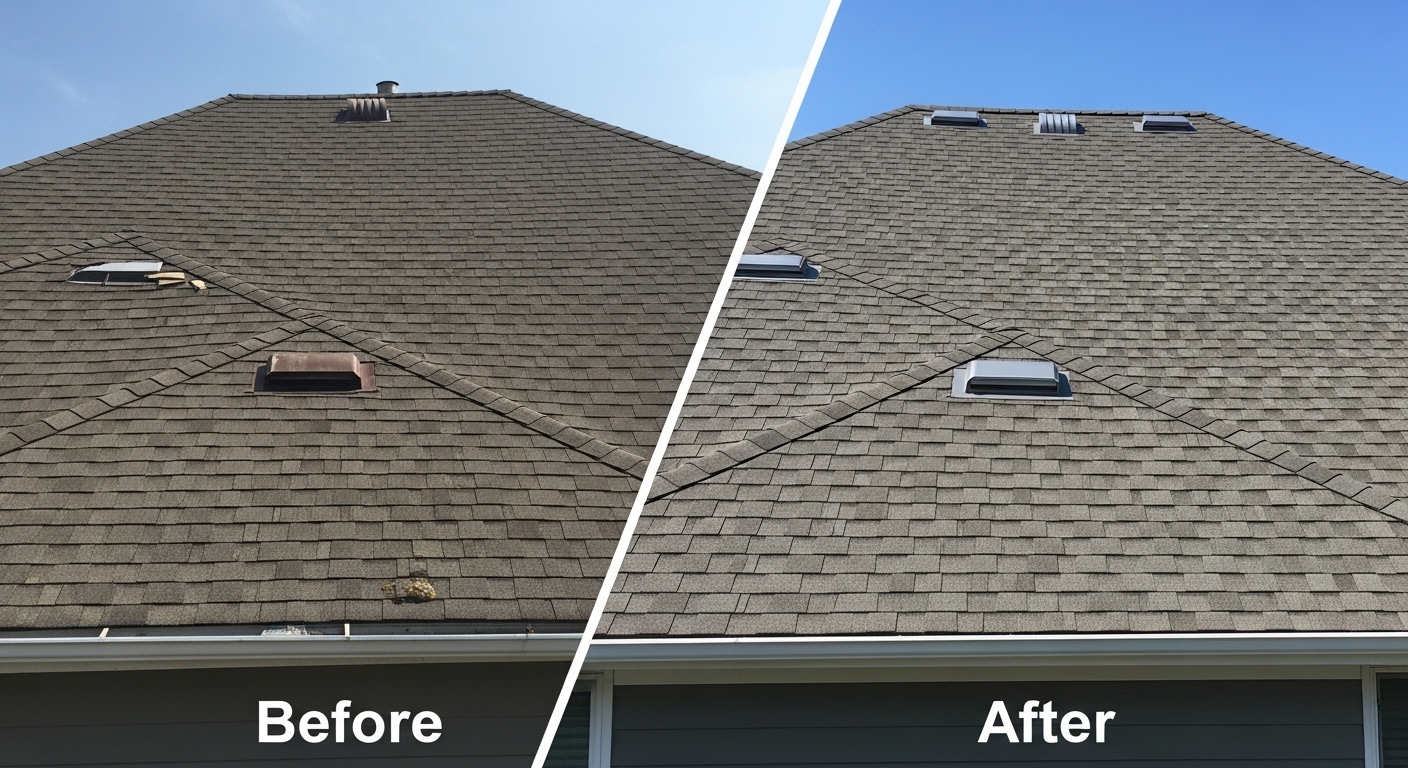
Measured comfort or energy outcomes require separate evidence; installation photos alone do not establish those results.
How We Plan Roof Vent Installation and Repairs
Compatibility and installation details matter.
Roof ventilation components must suit the roof covering, pitch, configuration, and intended assembly. Manufacturer instructions and applicable requirements guide openings, placement, fastening, and weatherproofing—not a universal dimension copied from another project.
Our planning considerations include:
- Product compatibility with the existing roof
- Published net-free ventilation area
- Intake and exhaust distribution
- Required airflow channels near insulation
- Flashing and surrounding roofing details
- Appropriate fasteners and accessories
- Roof condition at the proposed installation location
- Separate treatment of intentionally unvented assemblies
Net-free ventilation area describes the effective open area available for airflow, rather than the outside dimensions of a vent. Ventilation planning relates that area to the attic or ceiling area served and the relevant design requirements.
Can Attic Ventilation Be Improved Without Replacing the Roof?
Often, a targeted repair or retrofit deserves consideration first.
A ventilation concern does not automatically mean you need a complete roof replacement. The appropriate scope depends on component condition, roof access, layout, and the surrounding materials.
| Situation | Targeted Work May Be Appropriate | Broader Work May Be Needed |
|---|---|---|
| Damaged individual vent | Replace or repair the component | If surrounding roofing is deteriorated |
| Obstructed intake | Restore the appropriate pathway | If the intake design itself is unsuitable |
| Inadequate existing configuration | Plan a compatible retrofit | If roof geometry or condition limits options |
| Moisture-damaged decking | Investigate and repair the cause | Replace affected materials where necessary |
| Roof already due for replacement | Temporary repairs may help short term | Coordinate ventilation with the replacement |
| Intentionally unvented attic | Do not add vents automatically | Obtain assembly-specific evaluation |
Broader replacement may be appropriate when roof materials are substantially deteriorated, repair areas are extensive, or the project needs a coordinated redesign.
What Affects Attic Ventilation Costs in Stafford, VA?
A written estimate should explain the work—not just the total.
Roof ventilation installation cost varies with the property and proposed solution. An accessible soffit repair is different from a retrofit requiring work on a steep roof, multiple attic spaces, or damaged decking.
Main cost drivers:
- Roof height, pitch, and access
- Vent type and quantity
- Existing intake and exhaust configuration
- Roofing materials disturbed by the work
- Attic access and insulation conditions
- Repair of damaged surrounding materials
- Electrical work where powered equipment is proposed
- Emergency mitigation versus scheduled installation
| Service | Pricing Basis |
|---|---|
| Ventilation assessment | Scope, access, and property complexity |
| Soffit vent repair | Materials, affected area, and surrounding condition |
| Ridge vent installation | Roof layout, installation length, and roofing work |
| Static roof vent replacement | Product and weatherproofing requirements |
| Ventilation retrofit | Existing design and coordinated changes |
| Related roof repairs | Damage extent and materials involved |
Ask for the assessment scope, proposed work, exclusions, and payment terms in writing. Any incentive should be reviewed against the actual qualifying project rather than assumed to apply.
Request an Attic Ventilation EstimateWhen Should You Have Your Roof Ventilation Checked?
Persistent symptoms and major property changes deserve attention.
Consider an assessment when:
- The upstairs remains uncomfortable after insulation work
- Soffit openings appear covered or damaged
- You have a ridge vent but do not know where intake enters
- Dampness or musty odors keep returning
- A roof vent leaks during rain
- The roof is being replaced
- A garage or addition has a separate attic
- Someone recommends an attic fan without reviewing the existing system
- Spray foam or another major insulation change is planned
Adding insulation does not correct every source of heat loss or moisture. Air leakage and insulation performance should be considered together with ventilation.
Commercial Attic Ventilation for Stafford Buildings
The roof assembly determines the solution.
Hart Staff Roofing can discuss roof ventilation concerns for suitable commercial and multifamily properties. Before recommending conventional attic vents, we establish whether the building has a vented attic, a compact roof assembly, or another configuration.
Not every low-slope commercial roof needs residential-style intake and exhaust. Designed unvented assemblies require their own moisture-control and insulation approach.
| Commercial Service | Project Focus |
|---|---|
| Roof ventilation assessment | Existing configuration and visible condition |
| Vent repairs | Damaged components and surrounding roofing |
| Retrofit planning | Suitable changes to an existing vented assembly |
| Roof replacement coordination | Integrating ventilation with the roofing scope |
| Documentation | Findings, approved work, and maintenance recommendations |
Suitable inquiries may include offices, community buildings, churches, retail properties, rental portfolios, and multifamily housing.
Why property managers contact us:
- One roofing contact for assessment and related repairs
- Project planning around access and occupants
- Clear identification of separate roof or attic areas
- Written scope for budgeting and approval
| Property Situation | Planning Consideration |
|---|---|
| Multiple buildings | Assessment by building or roof section |
| Occupied premises | Access and disruption planning |
| Shared ownership | Authorization and responsibility boundaries |
| Complex site | Safety and specialist coordination |
Where moisture concerns involve commercial plumbing, mechanical exhaust, or HVAC systems, those issues need the appropriate specialist rather than being treated as roof-vent defects.
Request a Commercial Roofing ProposalWhy Choose Professional Attic Ventilation Support?
Protect the roof while addressing the right problem.
Professional assessment helps you:
- Avoid buying equipment before understanding the existing system
- Identify damaged vents and associated roofing concerns
- Coordinate intake, exhaust, and insulation pathways
- Recognize when another trade needs to investigate
- Plan compatible installation details
- Obtain a clear record of findings and approved work
The benefit is not a promise that ventilation alone will eliminate every comfort or moisture complaint. It is a more informed route to the appropriate repair.
Why Roof and Attic Work Requires Care
A visible concern is a reason to call—not to climb.
Avoid walking on the roof, stepping between attic framing members, or working around unfamiliar electrical equipment. Access conditions can make even a small inspection unsafe.
- Do not enter an attic with suspected structural damage
- Avoid disturbing unknown insulation or contaminated materials
- Keep away from wet electrical equipment
- Do not cut ridge openings or install powered equipment without the appropriate expertise
- Report active water entry and visible damage from a safe location
Warning: If water is contacting electrical equipment, stay clear and obtain emergency help appropriate to the hazard.
Roof Attic Ventilation FAQs for Stafford Property Owners
Start with the symptoms, then decide what needs attention.
Insulation may not resolve air leakage, duct problems, HVAC imbalance, or an obstructed ventilation pathway. A roofing assessment can review roof vents and accessible attic conditions; a home-performance or HVAC assessment may also be appropriate.
A ridge vent needs a suitable intake arrangement to function as intended. Soffit vents are a common solution, but houses without soffits need an appropriate alternative design—not an assumption that ridge exhaust alone is sufficient.
Yes. Insulation can obstruct the intended pathway near the eaves. Properly installed baffles help maintain separation between insulation and the airflow channel.
Either is possible. Roof and flashing defects, indoor air leakage, and exhaust discharged into the attic are potential moisture sources. The pattern and timing of dampness help guide investigation, but appearance alone does not establish the cause.
Yes, if it discharges into the attic. Bathroom, kitchen, and dryer exhaust should terminate outdoors through appropriate arrangements—not rely on attic ventilation to remove the discharged moisture.
Contact a roofer for damaged roof vents, roof leaks, or roof-vent installation concerns. Insulation and air-leakage issues may require a home-performance professional; duct and equipment concerns may require HVAC support. Some projects need coordinated work.
Yes. The visible product does not establish that its opening, fastening, intake arrangement, or surrounding roofing meets the installation requirements. An inspection should review those details where access allows.
If it is disconnected from the main attic, it should not be assumed to receive the same airflow. The spaces and their intended assemblies need to be identified.
A vented cathedral assembly needs a suitable airflow channel within its configuration. Some roofs are designed to be unvented. The solution depends on the assembly rather than a generic vent recommendation.
Not necessarily. Intake, ceiling air leakage, insulation, and HVAC performance should be considered first. Powered exhaust can draw conditioned air into an attic through leaks in some configurations.
Sometimes. Compatible vent repairs or retrofits may be possible if the roof and surrounding materials are suitable. The assessment determines the appropriate scope.
Requirements vary by manufacturer and product. Review the actual warranty and installation documents rather than assuming every warranty has identical conditions.
Hart Staff Roofing offers 24/7 emergency availability for urgent roofing issues. Routine comfort assessments and planned ventilation installations are scheduled according to access, conditions, and project needs. Call (540) 930-6660.
Know What to Expect from Hart Staff Roofing
An agreed scope, explained recommendations, and a clear next step.
Your project should begin with an understanding of what will be assessed, what work is proposed, and what is outside the scope. We focus on helping you make a practical roofing decision without promising that one component will solve every building-performance issue.
If a concern arises after completed work, contact us with the project details so it can be reviewed against the agreed scope and applicable warranty terms.
Hart Staff Roofing
2834 Richmond Hwy
Stafford, VA 22554
United States
Roofing Credentials and Project Requirements
The right authorization depends on the work being performed.
Virginia contractor licensing distinguishes license class from the classification or specialty that defines authorized work. Roofing contracting is identified by the ROC specialty. A generic master or journeyman label does not replace the appropriate contractor authorization.
Relevant project information includes:
- Contractor business identity and applicable license details
- Authorization appropriate to the roofing scope
- Manufacturer requirements for selected products
- Electrical qualifications where powered equipment is involved
- Permit or inspection requirements applicable to the project
Ask about credentials relevant to your proposed work rather than relying on an unrelated badge list.
24/7 Emergency Roofing Support in Stafford
Active leaks and storm damage need a different response from routine overheating.
A broken roof vent, displaced ridge component, or storm-damaged opening can allow water into the building. Hart Staff Roofing offers around-the-clock emergency availability to discuss urgent roofing concerns and plan an appropriate response.
Emergency workflow:
- Describe the damage and immediate hazards by phone
- Discuss access, weather, and urgency
- Arrange suitable assessment or temporary mitigation
- Develop the permanent repair scope
- Document relevant findings and completed work
Urgent scenarios include:
- Active leakage around a roof vent
- Storm-displaced ventilation components
- Damaged roof openings
- Sudden ceiling water entry associated with roof damage
Persistent upstairs heat without active damage usually belongs in a scheduled assessment.
Call for Emergency Roofing Help: (540) 930-6660Documentation for Roof-Vent Damage and Related Repairs
Keep the condition, findings, and work clearly recorded.
If roof-vent damage is part of a suspected insured event, factual documentation can help you explain the incident to your insurer.
Relevant records may include:
- Photos of visible damage
- Inspection observations
- An itemized proposed repair scope
- Completed-work invoices
- Product information where relevant
- Dates and descriptions supplied by the property owner
Note: Coverage, deductibles, depreciation, and claim decisions depend on the policy and insurer. Our roofing documentation does not determine coverage or guarantee payment.
Roof Ventilation Product and Workmanship Warranty Terms
Different parts of a project may have different protection.
| Coverage Area | What to Review |
|---|---|
| Workmanship | The written terms applicable to installation or repair labor |
| Products | Manufacturer coverage for the selected component |
| Existing materials | Whether retained roofing is included or excluded |
| Related work | Terms for separately performed electrical or other services |
| Claim procedure | Required records, contacts, and reporting steps |
Warranty duration, exclusions, and maintenance conditions depend on the actual agreement and product. Keep your proposal, invoice, product details, and written warranty together.
An inspection report documents observations; it does not automatically create a warranty for the entire roof.
Five Equipped Service Vans Supporting Stafford Roofing Projects
The equipment plan follows the job requirements.
Hart Staff Roofing's five-van fleet supports our team's roofing assessments and projects. The work required determines the access arrangements, materials, tools, and specialist coordination.
Project preparation considers:
- Roof and attic access
- Required safety arrangements
- Selected vents and compatible accessories
- Surrounding roofing materials
- Documentation needs
- Electrical or other specialist involvement
Some projects can be completed in a straightforward visit; others require material ordering, additional access planning, or multiple stages. We do not promise every repair will be finished during the initial assessment.
Payment Planning for Larger Ventilation and Roofing Projects
Understand the full scope and any available funding terms.
A small vent repair and a roof replacement with ventilation improvements involve very different budgets. Begin with a written scope so you understand the necessary work before discussing how to pay for it.
When considering financing:
- Ask which options are available for your project
- Review approval requirements
- Compare promotional and ongoing rates
- Understand fees and repayment timing
- Check any deferred-interest conditions
- Keep the financing agreement separate from the roofing scope
Do not assume that every repair qualifies for a promotional payment program.
What Matters Beyond Roofing Awards?
Choose a provider based on relevant work, clear scope, and dependable communication.
Awards and manufacturer recognition can be useful background, but they do not explain whether a proposed ventilation solution fits your attic.
For this service, evaluate:
- The quality of the assessment
- The explanation of intake and exhaust
- Compatibility with the roof assembly
- The clarity of installation details
- Written scope and warranty terms
- Responsiveness to your questions
A strong recommendation should remain understandable even without a logo or award beside it.
Discount Inquiries for Stafford Roofing Customers
Understand eligibility and conditions before approving the work.
Senior homeowners, military households, veterans, and other customers can ask about any offers available when requesting an estimate.
For any proposed discount, clarify:
- Eligible services
- Qualifying customer categories
- Minimum project value, if applicable
- Whether materials and labor are both included
- Whether it can be combined with another offer
- Any restrictions affecting emergency work
The written estimate should show the applicable reduction rather than leaving the final price uncertain.
Hart Staff Roofing Service Hours in Stafford, VA
24/7 emergency availability with planned projects scheduled separately.
| Day | Emergency Contact Availability |
|---|---|
| Monday | 24 hours |
| Tuesday | 24 hours |
| Wednesday | 24 hours |
| Thursday | 24 hours |
| Friday | 24 hours |
| Saturday | 24 hours |
| Sunday | 24 hours |
Routine inspections, ventilation installations, and nonurgent repairs are scheduled according to project requirements, access, weather, and crew availability.
What Should You Compare Between Attic Ventilation Contractors?
A useful proposal explains why the work is appropriate.
| Comparison Point | What a Clear Proposal Should Explain |
|---|---|
| Assessment scope | What will be inspected and what access is required |
| Existing configuration | Where intake and exhaust are located |
| Diagnosis | Why the proposed roofing work addresses the finding |
| Ventilation sizing | The basis for selecting components and capacity |
| Installation | Product requirements and surrounding roofing details |
| Related problems | Issues needing insulation, HVAC, electrical, or other support |
| Price | Included work, exclusions, and possible additional items |
| Warranty | Actual product and workmanship terms |
| Scheduling | Assessment, installation, and emergency availability |
Ask Hart Staff Roofing to walk you through the recommendation. A higher vent count or a larger fan is not, by itself, evidence of a better design.
Contact Hart Staff Roofing for Roof and Attic Ventilation
Tell us what you are noticing and what has already been tried.
Whether your upstairs remains hot after insulation work, a ridge vent appears ineffective, or attic dampness keeps returning, the next step is understanding the cause.
Contact Hart Staff Roofing to discuss an assessment, roof-vent repair, ventilation retrofit, or ventilation planning during roof replacement. Include your address, roof type if known, recent work, and when the symptoms occur.
Contact Hart Staff Roofing
(540) 930-6660
hartstaffroofing@gmail.com
Roof Attic Ventilation
2834 Richmond Hwy
Stafford, VA 22554, USA
24/7 Emergency Service Available
Current Special Offers
- Complimentary Tune-Up Assessment Bundle
- Hometown Heroes Community Discount
- No Interest, No Payments Financing Promo
- Roof & Gutter Combo Discount
- Tiered Project Value Markdown
Take the next step toward a clearer diagnosis and an appropriate roofing solution with roof attic ventilation in Stafford, VA, from Hart Staff Roofing.