Storm-Damaged Roof Repair & Replacement in Stafford, VA
Storm damage roofing in Northern Virginia focused on protecting your property and explaining your options.
When you need storm damage roof repair in Stafford, VA, the first priority is stopping further damage—not deciding on a new roof before anyone has inspected it. Hart Staff Roofing helps homeowners and commercial property owners address missing shingles, roof leaks, damaged flashing, and debris impacts with a clear path from assessment to repair or replacement.
Serving the Stafford community since 2010, our team brings 50 professionals and five equipped service vans to residential and commercial roofing work. Whether shingles blew off overnight or a ceiling stain appeared after heavy rain, contact us for inspection scheduling, temporary-protection options, and a written explanation of the recommended work.
- Roof inspections addressing wind, hail, leaks, and debris impacts
- Repair and replacement recommendations based on roof condition
- Written scopes that distinguish temporary protection from permanent work
- Emergency roofing inquiries accepted throughout Stafford and surrounding service areas
Call for 24/7 emergency inquiries and inspection scheduling. On-site work depends on weather, safe access, and availability.
Request Storm Damage Service
Fill out the form and we'll contact you immediately!
Local Roofing Experience with Clear Recommendations
Understand the damage, the proposed work, and the next step before making a major decision.
A storm creates enough uncertainty without a confusing roofing proposal. Hart Staff Roofing focuses on explaining what is damaged, what can be repaired, and what conditions may justify replacement. Our approach starts with the property—not a predetermined recommendation to install a new roof.
Trust highlights:
- Established in 2010 and serving the Stafford community
- A supplied operating team of 50 roofing professionals
- Five equipped service vans supporting local operations
- Residential and commercial roofing services
- 24/7 emergency contact availability
- Clearly defined project scope and payment expectations
Storm Damage Roof Services Near Stafford's Neighborhoods and Landmarks
Serving properties around Stafford Courthouse, Garrisonville, Aquia Harbour, and surrounding communities.
A roof leak near Government Island needs the same careful assessment as missing shingles in Embrey Mill or debris damage near Falmouth: identify the opening, assess surrounding materials, and develop an appropriate repair plan.
Hart Staff Roofing serves local properties from its Richmond Highway address, with roofing inquiries welcomed from Stafford communities and the wider Northern Virginia service market.
Local coverage:
- Communities: Aquia Harbour, Embrey Mill, Colonial Forge, Augustine, Hampton Oaks, Austin Ridge, Park Ridge, and Woodstream
- Additional Stafford locations: Garrisonville, Stafford Courthouse, Falmouth, and Widewater-area communities
- Wider service-area inquiries: Alexandria, Arlington, Centreville, Leesburg, McLean, and Reston
- Recognizable local destinations: Aquia Episcopal Church, Government Island, Aquia Landing Park, and Stafford Civil War Park
Tell us the property address when calling so we can discuss scheduling and service availability.
Roofing-Specific Assessment for Shingles, Flashing, Metal, and Low-Slope Systems
Evaluate the roof assembly—not just the most visible damaged spot.
A missing shingle may be the obvious problem, but surrounding fasteners, flashing, underlayment, and decking can affect whether a repair will perform properly. Wind can loosen shingle seals without removing the shingles, while debris impacts can create openings that are difficult to see from the ground.
Our roofing work addresses:
- Asphalt shingle repair and replacement
- Flashing around chimneys, walls, vents, and penetrations
- Metal and specialty roof repair considerations
- Low-slope and flat-roof damage
- Roof leak assessment and damaged-decking concerns
You receive recommendations suited to the materials and condition found at your property.
What Happens When a Storm Damages Your Stafford Roof?
Small openings can create problems beyond the visible roof surface.
Storm damage occurs when wind, hail, or falling debris compromises the roof's ability to shed water. Missing shingles are easy to recognize; loosened seals, damaged flashing, and impact-related defects may require closer inspection. Water entering the roof can affect decking, insulation, ceilings, and walls.
Common warning signs:
- Shingles missing, displaced, folded, or visibly creased
- New ceiling stains or damp interior surfaces
- Bent or detached flashing
- Branches or debris resting on the roof
- Damaged gutters and downspouts
- Wet attic insulation or stained roof decking
Important: Granules in a gutter do not, by themselves, prove hail damage. The roof's age, condition, and surrounding evidence matter. Call (540) 930-6660 for a professional assessment.
Prevent Bigger Problems with Scheduled Roof Assessments
Maintain useful records and respond promptly when conditions change.
Roof maintenance and post-storm inspections serve different purposes. Routine assessments identify wear, drainage concerns, and developing defects. A post-storm inspection looks for damage associated with a particular event and determines whether temporary protection or repairs are needed.
| Task | Description | Typical Timing | Practical Impact |
|---|---|---|---|
| Visual condition assessment | Review accessible roof surfaces and visible defects | According to roof condition and maintenance plan | Identifies developing concerns |
| Flashing and penetration review | Examine vulnerable transitions and roof openings | During inspection | Helps identify potential leak paths |
| Drainage review | Assess gutters, outlets, and debris-related concerns | Before heavy-use weather periods | Supports water drainage |
| Post-storm assessment | Evaluate missing materials and impact damage | After suspected damaging weather | Guides mitigation and repairs |
| Written findings | Record observed conditions and recommendations | Following the assessment | Supports planning and recordkeeping |
Seasonal planning:
- Arrange inspections before an existing leak faces another period of heavy rain
- Review drainage when leaves and debris accumulate
- Coordinate commercial roof access with property-management schedules
Frequency: Inspection intervals depend on roof type, condition, warranty terms, and property requirements. Roofing maintenance is not automatically an annual government-certification service.
Cost: Assessment and maintenance pricing depends on access, roof size, and the agreed scope.
Owner maintenance:
- Keep inspection reports, invoices, and warranty documents
- Report new stains or leaks promptly
- Keep roof access areas clear
- Leave damaged-roof access to appropriately equipped professionals
Who Can Request Storm Damage Roofing in Stafford?
From individual homeowners to commercial property managers.
Hart Staff Roofing works with property owners who need a clear explanation of roof damage and practical repair options.
Property types:
- Single-family homes
- Rental homes and investment properties
- Townhomes and association-managed buildings
- Apartments and multifamily properties
- Offices, retail buildings, and mixed-use properties
- Churches, community buildings, and other managed facilities
For shared roofs or association-managed properties, identify who can authorize the inspection and approve the work before scheduling.
How Can Wind, Rain, and Seasonal Changes Affect Your Roof?
Storm damage does not always begin with a shingle blowing away.
Wind can lift shingle edges or weaken their seal. Heavy rain can then expose an opening that previously caused no noticeable indoor leak. Hail and debris can damage roof coverings, flashing, and drainage components.
Spring & Summer
Assess suspected wind, hail, and debris damage following thunderstorms.
Autumn
Watch for drainage obstruction and branches resting on roof surfaces. Combine with gutter cleaning.
Winter
Existing openings can become more problematic when moisture freezes or snow and ice add stress.
A nearby storm report helps establish context, but it does not prove damage at an individual address. The roof itself must be assessed.
Roof Types We Assess for Storm-Related Damage
Material compatibility and underlying condition influence the repair plan.
A repair that works for asphalt shingles may not be suitable for standing-seam metal, slate, cedar shakes, or a single-ply membrane. The assessment should address both the damaged covering and the components beneath it.
| Roof Type | Typical Application | Inspection Focus | Repair Consideration |
|---|---|---|---|
| Asphalt shingles | Homes and some commercial properties | Missing, creased, or impact-damaged shingles | Surrounding shingle condition and repairability |
| Standing-seam metal | Residential and commercial buildings | Panels, seams, attachments, and flashing | System-specific detailing |
| Cedar shakes | Specialty residential roofing | Splitting, displacement, and surrounding deterioration | Compatible materials and condition |
| Slate and specialty roofing | Historic or premium properties | Broken units, attachments, and flashing | Skilled handling and material availability |
| Low-slope membranes | Commercial and selected residential roofs | Punctures, seams, edges, and drainage | Compatible repair materials and assembly condition |
Long-term reliability depends on appropriate installation, drainage, maintenance, and timely repair—not the covering alone.
Our 6-Step Storm Damage Roofing Process
Know what happens before, during, and after the work.
Initial Call & Property Assessment
Describe the storm, visible damage, active leaks, property type, and any immediate safety concerns.
Site Inspection & Access Planning
Assess access, weather conditions, and the areas that can be inspected safely.
Roofing Diagnostics & Documentation
Examine relevant roof surfaces, flashing, drainage components, and accessible signs of interior water intrusion.
Repair or Replacement Recommendations
Explain the findings, repairability concerns, proposed scope, and any conditions that require further assessment.
Approved Work & Project Records
Complete the contracted work and document authorized changes, including additional damage discovered during construction.
Final Review & Follow-Up
Review completion information, applicable warranty terms, and maintenance recommendations.
Temporary protection and permanent reconstruction are separate decisions, particularly when an insurer needs to inspect the loss.
What Is Included in a Storm Damage Roof Service?
A defined scope helps prevent misunderstandings.
The work included depends on whether you request an inspection, temporary mitigation, a repair, or a replacement. Your written proposal should identify the services being authorized and any exclusions.
Scope checklist:
- Property and damage description
- Defined inspection or work areas
- Photographs and written findings where included
- Recommended repair or replacement work
- Materials and relevant installation details
- Temporary protection when separately authorized
- Cleanup and disposal responsibilities
- Additional-work approval procedure
- Applicable warranty information
Note: Tree removal, structural engineering, electrical repairs, interior restoration, and extensive decking replacement should not be assumed included unless stated in the agreement.
Practical Advantages of Working with Hart Staff Roofing
Understand the recommendation instead of relying on a sales pitch.
Our service approach emphasizes the details that matter when you are comparing roofing options after a storm.
- Roofing services covering both repair and replacement
- Residential and commercial project support
- Written recommendations tied to observed conditions
- Separation of temporary protection from permanent work
- Documentation useful for property records and insurance discussions
- Direct contact with a locally based business
A clear proposal should explain why the work is recommended—not simply present a total price.
What Changes After Storm Damage Is Properly Addressed?
The outcome should be visible in the work and understandable in the records.
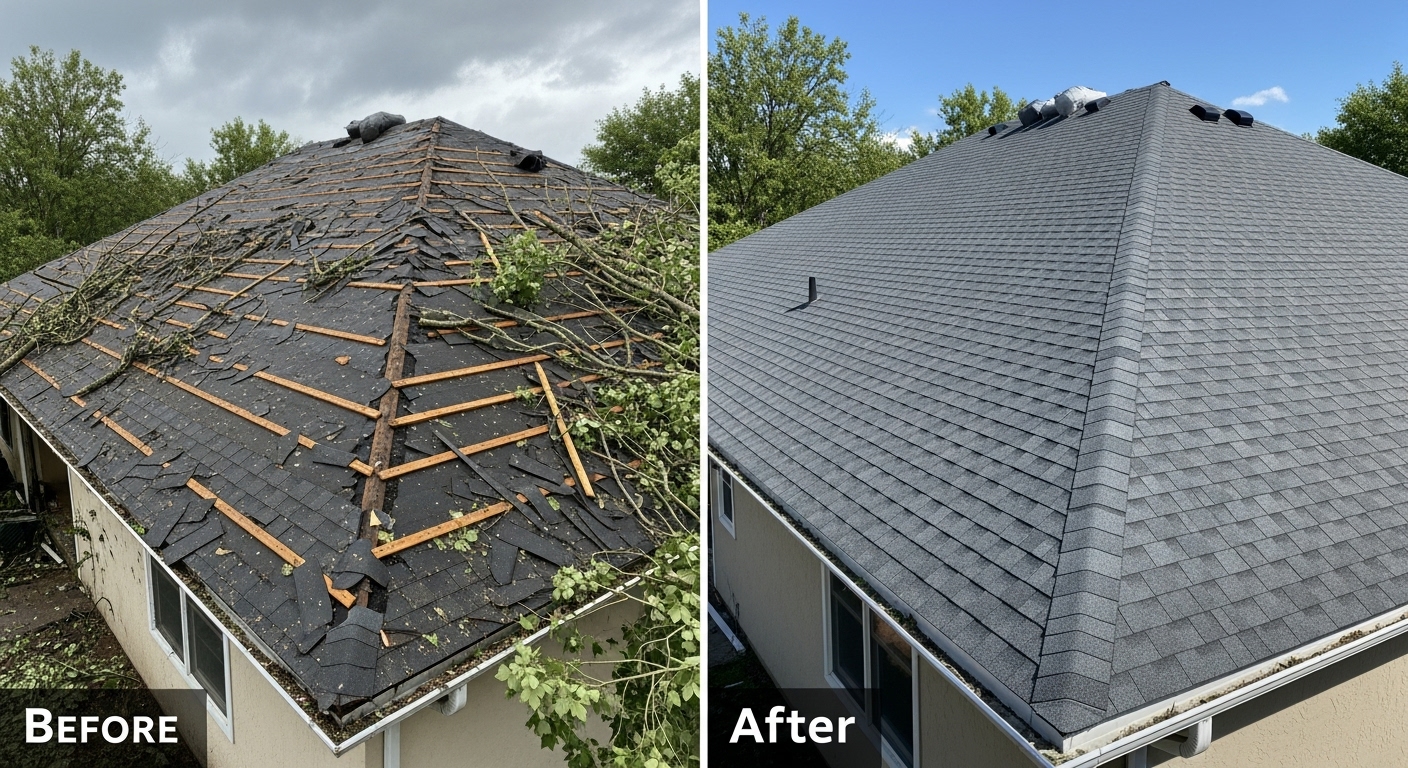
A useful roofing transformation is more than a cleaner-looking surface. It connects the original problem to the repair method and explains what was—and was not—included.
Before
Missing shingles and exposed areas.
After
An appropriately detailed repair or replacement of the affected roofing.
Before
A new leak with an uncertain entry point.
After
Documented findings and corrective work addressing the identified source.
Before
Conflicting assumptions about replacement.
After
An explanation of roof condition and practical options.
Before
Scattered photos and verbal promises.
After
Organized scope, invoices, and completion information.
Project images should document the actual work, not imply that every property requires the same solution.
How We Approach Storm-Damaged Roof Repairs and Replacement
Compatible materials and appropriate detailing support lasting performance.
Roofing repairs must integrate with the existing assembly. Replacing a damaged covering without addressing affected flashing, underlayment, or decking can leave the underlying problem unresolved.
Methods considered in the project scope:
- Compatible replacement shingles or roofing materials
- Underlayment and leak-barrier integration where required
- Flashing details around chimneys, walls, and penetrations
- Assessment of exposed decking during authorized tear-off
- Manufacturer-specific fastening and installation practices
- Roof-edge and drainage details
- Protection of landscaping and accessible property areas
Material selection should account for the roof system, installation requirements, project scope, and available warranty options.
Should Your Storm-Damaged Roof Be Repaired or Replaced?
Make the decision from condition and repairability—not fear.
Repair may be appropriate when damage is localized and the surrounding roof can accept compatible work. Replacement may be appropriate when damage is widespread, the assembly is significantly compromised, or reliable repairs are impractical.
| Scenario | Repair May Be Appropriate | Replacement May Be Appropriate |
|---|---|---|
| Limited missing shingles | Surrounding materials remain serviceable | Wider damage or poor repairability is found |
| Localized flashing defect | Adjacent roofing permits proper integration | Broader assembly problems are present |
| Isolated debris puncture | Damage can be fully accessed and corrected | Extensive deck or structural damage exists |
| Brittle or deteriorated roofing | Only where reliable integration is possible | Repairs would repeatedly damage surrounding materials |
| Multiple damaged roof areas | A complete, coherent repair scope is feasible | Distributed damage makes partial work impractical |
Replacement indicators:
- Extensive damage across multiple areas
- Compromised underlying materials
- A roof condition that prevents reliable repair
- Repeated leaks linked to broader assembly deterioration
Roof age, color mismatch, and an insurer's payment decision are not interchangeable with a technical replacement assessment.
What Affects Storm Damage Roof Repair Costs in Stafford, VA?
The same visible symptom can involve very different work.
A small missing-shingle area and a puncture with damaged decking may look similarly limited from the ground but require different repairs. The estimate should explain materials, labor, access, disposal, and conditions that could change the price.
Main cost drivers:
- Size and distribution of the damaged areas
- Roof height, pitch, and access
- Roofing material and availability
- Flashing and underlayment work
- Tear-off and disposal requirements
- Hidden decking damage
- Temporary protection
- Permit and structural requirements where applicable
| Service Type | Pricing Basis |
|---|---|
| Roof inspection | Roof size, access, and report scope |
| Emergency mitigation | Materials, access, urgency, and protection required |
| Localized repair | Damage extent and integration with existing roofing |
| Partial replacement | Defined roof areas and assembly requirements |
| Full replacement | Complete system scope, tear-off, materials, and underlying conditions |
Your written estimate is more useful than an unsupported "average" that does not describe your roof.
Request a Storm Damage Roofing EstimateWhen Should You Arrange a Storm Damage Roof Inspection?
New symptoms deserve assessment even when the damage looks small.
You do not need to wait for a major leak before asking about an inspection. Equally, a storm passing nearby does not automatically mean your roof needs replacement.
Service triggers:
- Shingles found in the yard after high winds
- New ceiling stains or damp insulation
- A branch or tree striking the roof
- Roofing materials visibly displaced
- Bent or detached flashing
- Repeated leakage after wind-driven rain
- Uncertainty about a proposed repair or replacement
For commercial storm damage roof repair, also report affected equipment areas, tenant impacts, and any access restrictions.
Commercial Storm Damage Roofing in Stafford County
Coordinate roofing work around people, access, and business operations.
Commercial roofing decisions involve more than the roof surface. Property managers may need temporary protection, tenant communication, controlled access, and a repair plan that distinguishes urgent work from a larger capital project.
| Service | Description |
|---|---|
| Damage assessment | Review affected roofing and relevant assembly conditions |
| Temporary mitigation | Address water entry where safe and feasible |
| Repairs | Correct defined defects using compatible methods |
| Replacement planning | Develop scope for wider roofing work |
| Project documentation | Provide agreed findings, estimates, and completion records |
Properties served:
- Offices and retail buildings
- Multifamily and association-managed properties
- Churches and community facilities
- Hospitality and other managed commercial buildings
Commercial planning considerations:
| Project Type | Key Consideration |
|---|---|
| Occupied building | Access control and occupant coordination |
| Multiple buildings | Prioritization by damage and risk |
| Low-slope roof | Seams, penetrations, edges, and drainage |
| Larger replacement | Phasing, material delivery, and weather planning |
Why Professional Storm Damage Roofing Matters
A documented assessment supports a more confident decision.
Professional roofing work helps connect the visible problem to the underlying condition. That matters when water appears far from its entry point or when a surface patch would leave affected components untreated.
Benefits:
- Identify damage that is difficult to assess from the ground
- Understand whether a repair is practical
- Address vulnerable roof transitions and openings
- Receive a clearly defined scope
- Maintain records for future maintenance and insurance discussions
- Avoid unnecessary assumptions about full replacement
A sound recommendation explains both the proposed work and its limitations.
What Should You Avoid After a Roof-Damaging Storm?
Stay off damaged roofs and away from electrical or structural hazards.
Do not climb onto a storm-damaged roof to take photos, move branches, or install a tarp. Wet surfaces, unstable materials, and concealed openings can make access dangerous.
- Stay clear of downed power lines and contact emergency services or the utility
- Keep people away from sagging ceilings and suspected structural damage
- Do not touch water near lights, wiring, or electrical equipment
- Do not attempt to remove a tree resting on the building
- Photograph visible damage only from a safe location
- Leave unsafe areas and call 911 when there is immediate danger
Warning: Roofing service is not a substitute for emergency electrical, fire, or structural response.
Storm Damage Roof Repair & Replacement FAQs in Stafford
Clear answers before you commit to the work.
Keep people away from electrical hazards and sagging ceilings, document what you can safely see, and arrange professional assessment and temporary protection. Notify your insurer promptly if you intend to report the loss.
Necessary temporary protection should not be delayed simply because the adjuster has not arrived. Photograph the damage where safe and retain receipts. Coverage and reimbursement depend on the policy and reasonable expenses.
No. The decision depends on surrounding roof condition, damage extent, compatible materials, and whether the repair can be completed reliably.
Yes. Wind can loosen seals, lift edges, or crease shingles while they remain attached. See our wind damage repair services for more details.
Yes. Some defects compromise the covering before water becomes visible indoors. An absence of ceiling stains does not establish that the roof is undamaged.
Water can travel along roof components or framing before appearing indoors. Locating the visible stain alone may not identify the entry point. A professional leak detection assessment can help.
Coverage depends on the cause, policy terms, exclusions, deductible, and assessment. A roofer documents roofing conditions; the insurer determines coverage.
Compare the scopes and identify differences in quantities, materials, labor, and hidden damage. Send the supporting information to the insurer. Virginia's Bureau of Insurance provides consumer assistance when disputes remain unresolved.
No. Material availability, repairability, policy language, and applicable requirements need individual consideration.
Requirements depend on the work. Covering replacement, decking work, structural repairs, and other alterations should not be assumed to have identical requirements. Resolve the project's permit responsibilities before permanent work begins.
Retain photographs, inspection findings, estimates, contracts, invoices, temporary-repair receipts, claim correspondence, and warranty documents.
Yes. Hart Staff Roofing accepts emergency inquiries 24/7. Safe on-site response depends on weather, access, and availability. Call (540) 930-6660.
Know What Is Being Recommended—and Why
Defined scope, straightforward communication, and documented terms.
Hart Staff Roofing's service approach centers on helping you understand the roof condition and the proposed work. Before authorizing a repair or replacement, review the materials, inclusions, exclusions, payment schedule, and applicable warranty provisions.
If a concern arises after completed work, contact us with the project details so the issue can be assessed against the agreed scope and warranty terms.
Hart Staff Roofing
2834 Richmond Hwy
Stafford, VA 22554, United States
Roofing Licenses and Contractor Credentials
Understand the difference between business licensing and manufacturer programs.
Virginia contractor licenses are issued to business entities. Roofing contracting is identified by the ROC specialty; license class and specialty describe different aspects of the authorization.
Credential categories relevant to a roofing proposal:
- Virginia contractor license class
- Roofing contracting specialty
- Residential or commercial classifications where applicable
- Manufacturer contractor-program credentials
- System-specific installation training
- Project-relevant safety and technical qualifications
A credential should relate to the business performing the work and the roofing system being proposed. Manufacturer program membership does not make an independent contractor an employee of the manufacturer.
Emergency Roof Repair and Tarping Inquiries in Stafford
Address urgent water entry while planning the permanent solution.
An active leak or exposed roof area may need temporary protection before a complete repair can be scheduled. Contact Hart Staff Roofing to describe the conditions and discuss the next safe step.
Emergency process:
- Assess the reported symptoms and immediate hazards by phone
- Discuss property access and weather constraints
- Arrange on-site assessment when feasible
- Identify suitable temporary protection
- Develop a permanent repair or replacement scope
- Retain documentation of authorized mitigation
Emergency scenarios:
- Active water intrusion
- Shingles missing before additional rainfall
- Debris punctures
- Displaced flashing or roofing materials
- Tree-impact damage after the immediate hazard is addressed
A tarp is temporary protection—not a substitute for repairing the damaged roof assembly.
Call (540) 930-6660 — 24/7 EmergencyHelp Organizing a Storm Damage Roof Claim
Clear records help explain the damage and proposed corrective work.
A claim can become confusing when the contractor's scope and insurer's estimate describe different work. Hart Staff Roofing can provide roofing documentation associated with the services performed so you can discuss those differences with your insurer. Related hail damage or wind damage documentation may also apply.
Documentation may include:
- Inspection observations and photographs
- Location and extent of identified damage
- Written repair or replacement recommendations
- Estimates and authorized scope changes
- Additional damage documented during construction
- Invoices and completion records
Understanding common terms:
| Term | Description |
|---|---|
| ACV | Actual cash value, generally reflecting depreciation under the policy |
| RCV | Replacement cost value, subject to policy conditions and limits |
| Recoverable depreciation | An amount that may become payable after qualifying repairs or replacement |
| Deductible | The portion applied according to the policy's terms |
Wind and hurricane deductibles may operate differently. Review the actual policy rather than assuming a single deductible applies to every storm loss.
Policy note: Hart Staff Roofing does not determine coverage or guarantee claim payment. Your insurer applies the policy to the reported loss.
Warranty Information for Roof Repairs and Replacement
Workmanship and material warranties are separate protections.
Warranty coverage depends on the contracted work, installed products, and applicable program terms. The proposal should identify what protection applies and how to report a concern.
| Coverage Type | What to Review |
|---|---|
| Workmanship | Covered installation or repair issues, term, exclusions, and remedy |
| Manufacturer materials | Product eligibility, defect coverage, and limitations |
| Enhanced manufacturer coverage | Required products, contractor eligibility, and registration |
| Transfer provisions | Whether coverage transfers and any conditions |
| Project records | Documents needed to support a warranty inquiry |
Important notes: A roofing warranty does not automatically cover new storm damage, unrelated leaks, neglected maintenance, or every component of the building. Review the written terms for your project.
Five Equipped Service Vans Supporting Stafford Roofing Work
Resources for assessment, service, and project coordination.
Hart Staff Roofing's supplied fleet includes five equipped service vans, supported by a team of 50 professionals. Fleet capacity helps coordinate work, but each project still requires appropriate materials, access planning, and weather conditions.
Equipment and resource priorities:
- Roofing inspection and measurement equipment
- Appropriate access and fall-protection equipment
- Temporary-protection materials suited to the task
- Roofing tools for approved repairs
- Project-specific material deliveries
- Communication between assessment and construction teams
Larger replacements and specialty systems require dedicated planning; they should not be assumed achievable from a service van in one visit.
Discuss Payment Options for Major Roof Projects
Separate the project cost from the insurance payment.
A roof replacement may involve deductibles, uncovered work, upgrades, or a gap between payment timing and project needs. Ask Hart Staff Roofing about payment arrangements and any financing options available for your proposed work.
Points to discuss:
- Whether financing is available for the project
- Application and approval requirements
- Interest rate and repayment schedule
- Fees and promotional conditions
- Whether deferred interest applies
- Payment milestones in the roofing contract
"No interest" and "no payments" offers require written terms. Compare the full obligation—not just the promotional headline—before deciding.
Roofing Awards and Industry Recognition
Evaluate recognition alongside the actual project proposal.
Awards can provide context, but they do not replace a suitable scope, relevant qualifications, or clear warranty terms. Manufacturer designations and customer-service awards also measure different things.
Recognition categories:
- Local community recognition
- Customer-service awards
- Roofing-industry project awards
- Manufacturer contractor-program distinctions
- Installation or service-excellence recognition
For your roofing decision, give priority to the contractor's ability to explain your roof condition, perform the proposed work, and document the agreement. Recognition is supporting information—not a guarantee of insurance coverage or future roof performance.
Community Discounts and Roofing Promotions
Understand eligibility before including a discount in your budget.
Hart Staff Roofing's supplied offer list includes a Hometown Heroes community promotion and roof-and-gutter combination offers. Ask which programs apply to your property and proposed services.
Offer details to review:
- Military, veteran, or other qualifying community eligibility
- Whether a senior discount is currently available
- Eligible repairs or replacement projects
- Discount amount or maximum value
- Combination restrictions
- Financing exclusions
- Offer expiration and written proposal treatment
Only the offer included in your written agreement should be treated as part of the project price.
Hart Staff Roofing Hours in Stafford, Virginia
Call around the clock; on-site roofing work requires safe conditions.
Our operating schedule provides 24/7 contact availability for roofing inquiries and urgent storm-damage concerns. Inspection and construction scheduling depends on the work, weather, access, and available resources.
| Day | Contact Hours |
|---|---|
| Monday | 24 hours |
| Tuesday | 24 hours |
| Wednesday | 24 hours |
| Thursday | 24 hours |
| Friday | 24 hours |
| Saturday | 24 hours |
| Sunday | 24 hours |
When calling about an emergency, provide the address, whether water is actively entering, and any tree, electrical, or structural hazards.
How to Compare Storm Damage Roofing Providers in Stafford
Use a consistent checklist before authorizing a major project.
A lower total price may reflect a smaller scope. A replacement recommendation may reflect different assumptions about repairability. Compare the details so you understand what each proposal actually provides.
| Feature | Hart Staff Roofing Proposal Discussion | What to Ask Any Provider |
|---|---|---|
| Damage assessment | Explain observed roof conditions | What evidence supports the recommendation? |
| Repair options | Discuss repairability and replacement scope | Why is repair suitable or unsuitable? |
| Materials | Identify proposed roofing components | Are materials compatible with the system? |
| Hidden damage | Explain approval procedures | How are additional costs authorized? |
| Documentation | Define included records | Will findings and scope be in writing? |
| Warranty | Review applicable terms | What is covered, excluded, and required? |
| Payment | Discuss contract milestones | Is the payment schedule clearly stated? |
| Availability | Clarify scheduling constraints | Is the promise about contact, arrival, or completion? |
Be cautious of pressure to sign immediately or promises of a guaranteed "free insurance roof." Written estimates and established contractors are central recommendations in Virginia's homeowner guidance.
Contact Hart Staff Roofing for Roof Repair & Replacement in Stafford, VA
Describe the problem, ask about inspection availability, and understand your options.
If shingles blew off, your roof started leaking after a storm, or a proposed replacement leaves you uncertain, contact Hart Staff Roofing. We will discuss the property, the visible symptoms, and the next steps for assessment, temporary protection, or a written roofing proposal.
You do not need to know whether the roof requires repair or replacement before calling. Start with what changed and what you can safely observe.
Contact Hart Staff Roofing
(540) 930-6660
hartstaffroofing@gmail.com
Storm Damage Roof Repair & Replacement
2834 Richmond Hwy
Stafford, VA 22554, USA
24/7 Emergency Service Available
Current Special Offers
- Complimentary Tune-Up Assessment Bundle
- Hometown Heroes Community Discount
- No Interest, No Payments Financing Promo
- Roof & Gutter Combo Discount
- Tiered Project Value Markdown
Protect your property and make an informed repair decision with storm damage roof repair in Stafford, VA from Hart Staff Roofing.