Tile Roof Repair & Replacement in Stafford, VA
Northern Virginia Tile Roofing Services That Protect Your Property and Preserve Its Character
A leaking tile roof does not automatically need a complete replacement. Hart Staff Roofing approaches tile roof repair in Stafford, VA with a clear priority: identify the problem, explain the options, and recommend work that addresses the condition of your roof—not just its visible surface.
Serving the Stafford community since 2010, our team helps homeowners, property managers, and commercial owners navigate cracked tiles, recurring leaks, deteriorated underlayment, damaged flashing, and larger replacement projects. With 50 professionals and five equipped service vans, we bring organized project support and practical roofing experience to properties throughout Stafford County.
From the first conversation to the approved scope of work, the focus is clarity: what failed, what can remain, what needs attention, and what your investment covers.
Call Now for Tile Roofing HelpCall +1 (540) 930-6660 to discuss your roof, request an assessment, or ask about emergency assistance.
- Clay and concrete tile roof assessment, repair, and replacement planning
- Options for localized repairs and renewal of underlying roof components
- Clear explanations of flashing, underlayment, and concealed decking concerns
- 24/7 emergency contact availability, with roof access and work scheduled around safe conditions
Request Tile Roofing Service
Fill out the form and we'll contact you promptly!
Tile Roof Replacement in Stafford, VA, Backed by Local Experience
A Local Roofing Team Focused on the Entire Roof System
Your roof deserves more than a quick patch and an unexplained recommendation. Hart Staff Roofing helps you understand the relationship between the tiles you can see and the materials protecting the building beneath them.
Our approach centers on assessing relevant components, discussing repair alternatives, and defining the work before it begins. Whether your priority is stopping a leak, retaining suitable existing tiles, or planning a larger replacement, you should know why the proposed solution fits your property.
- Established in 2010 and based in Stafford
- A team of 50 professionals supporting roofing operations
- Five equipped service vans
- Residential and commercial roofing services
- Around-the-clock emergency contact availability
- Project-specific scope, material selections, and workmanship terms
Tile Roof Services Near Stafford Communities and Local Landmarks
Serving Stafford Courthouse, Aquia Harbour, Garrisonville, and the Wider County
A roof near Government Island, a home in Aquia Harbour, and a property in the Falmouth area can have very different repair needs. Roof material, access, previous work, nearby trees, and the condition of underlying components matter more than a one-size-fits-all recommendation.
Hart Staff Roofing serves properties throughout the Stafford area, including established communities and newer residential developments. For projects farther across Northern Virginia, we discuss the address, work scope, and scheduling before arranging service.
- Stafford-area communities: Austin Ridge, Autumn Ridge, Embrey Mill, Colonial Forge, Hampton Oaks, Park Ridge, Vista Woods, Woodstream, and surrounding communities
- County coverage: Stafford Courthouse, Aquia Harbour, Garrisonville, Falmouth, Hartwood, and Widewater
- Broader service inquiries: Alexandria, Arlington, Centreville, Leesburg, McLean, and Reston
- Familiar county destinations: Aquia Landing Park, Government Island, Stafford Civil War Park, and Widewater State Park
Landmark references describe the surrounding service area; they do not imply that Hart Staff Roofing has worked on those landmarks.
Why Does a Tile Roof Need a System-Specific Repair Approach?
Understand the Tiles, Underlayment, Flashing, and Decking Before Choosing the Work
Replacing a broken tile can be straightforward when the surrounding roof is sound. A recurring leak is different: the cause may involve flashing, drainage, underlayment, attachment details, or materials beneath the visible covering.
Tile Roofing Industry Alliance guidance recommends evaluating underlayment and roof decking when considering repair or replacement. Installing tiles over compromised underlying materials can leave the actual problem unresolved.
Hart Staff Roofing evaluates the repair scope around the roof's condition and configuration.
- Identify the material and tile profile before discussing replacements
- Assess relevant valleys, penetrations, and transitions
- Distinguish isolated damage from broader underlying concerns
- Explain whether existing tiles may be suitable for reuse
- Discuss material availability and limitations before work begins
Why Is Your Tile Roof Leaking When the Tiles Look Fine?
Visible Tiles Tell Only Part of the Story
Water inside the building does not always mean the tile directly above the stain is broken. Leak investigation may need to follow the water pathway through roof transitions and underlying materials rather than assume the entry point is immediately above the interior symptom.
Common concerns include cracked or displaced tiles, compromised flashing, debris accumulation, and damaged underlayment. Broken tiles can expose underlying protection to water and ultraviolet light, making timely assessment important.
Prevent Small Tile Roofing Problems from Becoming Larger Repairs
What Should a Routine Roof Inspection Include?
Preventive maintenance helps identify visible defects and drainage concerns before they become harder to manage. Your maintenance schedule should reflect the roof's age, manufacturer guidance, surrounding conditions, previous repairs, and significant weather events.
An ordinary tile roof should not be presented as requiring a universal annual pass/fail certification. Industry maintenance guidance recommends professional inspection after initial installation and periodically thereafter, with the specific schedule adjusted to the roof and applicable warranty instructions.
| Maintenance Task | Description | Typical Timing | Practical Value |
|---|---|---|---|
| Visual condition review | Assess visible broken, loose, or displaced tiles | Periodic inspection or after a reported concern | Identifies areas needing attention |
| Valley and gutter review | Look for excessive debris and drainage obstruction | Based on surrounding trees and accumulation | Supports intended water flow |
| Flashing assessment | Review accessible vents, stacks, skylights, and wall transitions | During inspection | Identifies compromised details |
| Interior symptom review | Discuss relevant stains, leaks, and previous repairs | When symptoms are reported | Helps direct investigation |
| Written findings | Explain observed conditions and recommendations | Following assessment | Supports informed decisions |
| Repair planning | Define approved corrective work | When a defect is identified | Separates maintenance from larger repairs |
Seasonal Planning
- Arrange an assessment before winter if the roof already has unresolved symptoms
- Review the roof after significant wind or hail when damage is suspected
- Coordinate debris maintenance with other exterior work and gutter cleaning
Frequency: use a roof-specific maintenance plan rather than assuming every property needs identical visits.
Cost: inspection and maintenance pricing depends on access, roof complexity, and the agreed scope.
Owner Preparation
- Keep previous roofing invoices and warranty documents
- Record when leaks occur and where stains appear
- Provide ground-level photographs when useful
- Leave rooftop assessment and maintenance to appropriately equipped professionals
Who Needs Tile Roof Repair or Replacement in Stafford?
Practical Support for Homeowners, Managers, and Commercial Owners
The right solution depends on the roof—not simply the building's category. Hart Staff Roofing helps property owners evaluate tile roofing concerns and plan work around access, appearance, occupancy, and budget.
For properties with special design restrictions, the proposed material and appearance should be considered alongside the repair scope.
How Do Northern Virginia Conditions Affect Your Tile Roof?
Consider Storm Exposure, Winter Weather, and Debris Accumulation
Stafford's regional planning documents identify severe storms and winter weather as relevant local hazards. These conditions support practical inspection planning, but they do not prove that every roof has the same exposure or failure pattern.
Roof performance also depends on the specific tile product, installation details, underlying materials, and maintenance history.
- Summer: assess suspected damage after significant storms rather than assuming every leak is storm-related.
- Winter: investigate leaks that appear during or after snow and ice events without jumping to a single diagnosis.
- Spring and fall: review accumulated leaves and other debris in drainage areas.
- Year-round: address known broken tiles, recurring interior symptoms, and compromised flashing.
Excessive leaves and pine needles should be removed from gutters and valleys to support proper water flow.
Clay Tile, Concrete Tile, and Related Roof Systems
Identify What Is on Your Roof Before Choosing Replacement Materials
"Tile roof" can describe different products and profiles. Repair planning begins with identifying the material, dimensions, condition, and compatibility of replacement pieces.
| Roof Material or System | Typical Appearance | Main Assessment Priorities | Repair-Planning Considerations |
|---|---|---|---|
| Clay tile | Flat or profiled pieces with varied finishes | Product condition, profile, attachment, underlying protection | Compatible replacements and specified installation details |
| Concrete tile | Flat, low-profile, or high-profile pieces | Condition, fit, drainage, underlayment, flashing | Reuse suitability and matching availability |
| Specialty tile profiles | Distinctive curves, interlocks, or dimensions | Product identification and compatibility | Avoid treating a similar appearance as an interchangeable product |
| Slate roofing | Natural stone roofing units | Separate material-specific assessment | Address through the appropriate slate roofing scope |
A durable visible covering does not remove the need to maintain flashing, drainage details, or underlying materials. The roof should be assessed as an assembly, not judged only by tile appearance.
Our 6-Step Tile Roof Assessment and Service Process
Know What Happens from the First Call to Project Completion
Initial Call & Property Assessment
Discuss the address, roof material if known, interior symptoms, previous repairs, and urgency.
On-Site Inspection & Access Planning
Establish safe access and review the areas relevant to the reported problem.
Roof-System Investigation
Assess tiles, flashing, drainage details, and underlying materials where included in the inspection scope.
Repair or Replacement Recommendations
Explain localized repair, renewal of underlying components, or replacement options based on findings.
Approved Work & Documentation
Complete the agreed work, address scope changes through approval, and provide relevant project records.
Final Review & Follow-Up
Review the completed scope, cleanup, applicable warranty terms, and recommended maintenance.
What Should Your Tile Roof Repair Proposal Include?
Know What Is Included Before Approving the Project
A useful proposal should do more than say "repair roof leak." It should identify the work area, components involved, material assumptions, and how additional findings will be handled.
For tile roof underlayment replacement in Stafford, the proposal should distinguish the underlying-material scope from tile removal, tile reuse, flashing work, and potential decking repairs.
- Description of the reported problem and relevant findings
- Defined work area and approved repair method
- Tile replacement or reuse provisions
- Underlayment and flashing scope where applicable
- Treatment of concealed decking damage
- Material availability and matching limitations
- Cleanup and disposal responsibilities
- Project documentation and applicable workmanship terms
Not every inspection or repair includes all these items. Your written agreement establishes the actual scope.
What Makes a Roofing Proposal Easier to Understand?
Clear Findings, Defined Options, and Straightforward Communication
Hart Staff Roofing focuses on explaining the decision before asking you to approve the work. A homeowner should understand why a localized repair is appropriate—or why a broader scope deserves consideration.
- Roof-specific recommendations rather than a generic sales script
- Clear separation of visible tile damage and underlying concerns
- Repair alternatives where the roof condition supports them
- Scope explanations for property owners and managers
- Emergency contact availability
- Coordination between approved work and follow-up needs
The goal is not to promise the smallest repair in every situation. It is to make the recommendation understandable.
What Changes After a Tile Roof Problem Is Properly Assessed?
Understand the Problem, the Work, and the Result
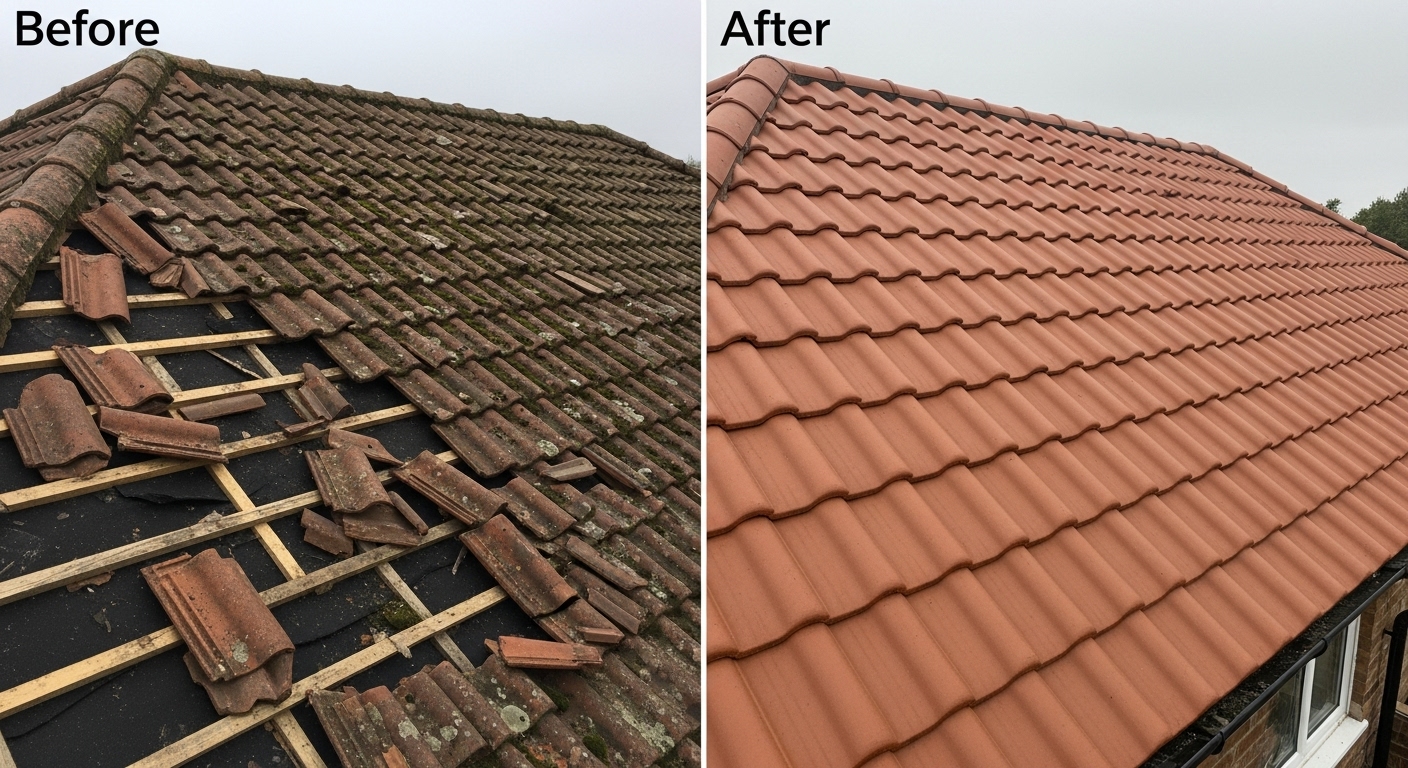
A meaningful roofing transformation is more than an improved appearance. The owner should understand which components were addressed and which parts of the existing roof remained outside the repair scope.
- Before: A ceiling leak with an unknown entry point. After: Findings that explain the investigated area and proposed corrective work.
- Before: Uncertainty about whether every tile needs replacement. After: A comparison of repair, underlying-component renewal, and replacement options.
- Before: A vague estimate with unclear exclusions. After: A defined scope describing materials, labor, concealed-damage handling, and applicable terms.
How Should Clay and Concrete Tile Roof Repairs Be Completed?
Match the Repair Method to the Product and Underlying Conditions
Repair methods should reflect the actual tile system and manufacturer instructions. The work may involve replacing damaged pieces, renewing flashing, addressing underlayment, or repairing decking exposed within the approved scope.
Industry guidance identifies flashing around vents, plumbing stacks, skylights, and wall transitions as critical to long-term roof performance.
- Select compatible tiles rather than relying only on a close color match
- Use underlying materials appropriate to the specified roof assembly
- Address damaged flashing where included in the scope
- Evaluate decking condition before covering identified damage
- Maintain intended drainage paths
- Apply the product's specified attachment and repair requirements
A surface coating or sealant patch should not automatically be treated as a substitute for correcting a failed underlying detail.
Can Your Tile Roof Be Repaired Instead of Replaced?
Compare the Options Before Committing to a New Roof
A localized defect may support a localized repair. Broader deterioration can require a larger scope. In some situations, suitable tiles can be retained while underlying components are renewed.
| Finding or Concern | Localized Repair | Underlying-Component Renewal with Tile Reuse | Full Replacement |
|---|---|---|---|
| Isolated broken tile | May be appropriate after checking the affected area | Usually requires broader justification | Not established by one broken tile alone |
| Localized flashing defect | May address the identified problem | Consider surrounding material condition | Evaluate only with supporting findings |
| Recurring leaks | Investigate why earlier work failed | May be worth assessing | Depends on broader condition |
| Widespread underlayment concern | May leave other areas unresolved | Evaluate tile suitability and project feasibility | Compare overall scope and materials |
| Extensive damage | Limited repairs may not be practical | Reuse may be restricted | Evaluate a new system |
| Unavailable matching materials | Discuss compatible options and limitations | Requires careful planning | May become part of the comparison |
When Replacement Deserves Serious Consideration
The assessment should explain the evidence behind the recommendation.
How Much Does Tile Roof Repair Cost in Stafford, VA?
Pricing Depends on Scope, Access, Materials, and Concealed Conditions
There is no responsible single price for every leaking tile roof. A small visible defect can involve straightforward work—or conceal a larger issue beneath the covering.
Hart Staff Roofing discusses pricing around the proposed scope so you can compare what different estimates actually include.
Main Cost Drivers
- Size and location of the repair area
- Roof height, slope, and access
- Tile profile and replacement availability
- Tile removal and reinstallation requirements
- Underlayment and flashing scope
- Concealed decking damage
- Cleanup and disposal
- Emergency assessment versus scheduled work
| Service Type | Estimate Basis |
|---|---|
| Inspection or leak assessment | Access, roof complexity, and agreed investigation |
| Isolated tile repair | Replacement availability and underlying condition |
| Flashing or valley repair | Extent of affected details and surrounding materials |
| Underlayment renewal | Area, removal scope, reuse feasibility, and flashing |
| Full replacement | Roof-system specification and complete project scope |
If additional damage is uncovered, the change in work and cost should be explained before proceeding beyond the authorized scope.
Which Tile Roof Warning Signs Deserve Attention?
Use Symptoms to Start the Conversation—Not to Diagnose the Entire Roof
You do not need to know the technical cause before contacting Hart Staff Roofing. Describe what you can observe safely, when it happens, and whether earlier work changed the symptoms.
Broken tiles should be addressed because they can expose underlayment to damage. However, appearance alone does not establish the condition of every component below them.
Tile Roofing Support for Commercial and Multi-Unit Properties
Coordinate Access, Scope, and Documentation Across Your Property
Commercial and shared-property projects require clear responsibilities. Hart Staff Roofing works with owners and managers to discuss building access, occupants, project sequencing, and approval of the work.
| Service | Description |
|---|---|
| Condition assessment | Review reported concerns and relevant roof areas |
| Localized repairs | Address defined defects within an approved scope |
| Replacement planning | Compare system condition, materials, and project requirements |
| Multi-building coordination | Organize work by property, building, or agreed phase |
| Project records | Provide relevant findings, scope, and completed-work documentation |
Applicable Property Inquiries Include:
Why Coordinated Service Matters
- Clear approval routes
- Building-specific scopes
- Defined access arrangements
- Communication with responsible stakeholders
| Commercial Project | Planning Considerations |
|---|---|
| Multiple buildings | Separate findings and priorities |
| Occupied property | Access and work-area coordination |
| Larger replacement | Material logistics and project sequencing |
| Restricted-access site | Property-specific safety and entry arrangements |
What Are the Benefits of Professional Tile Roof Assessment?
Identify the Failed Component Before Choosing the Repair
Professional assessment helps distinguish an isolated tile problem from an issue involving underlying materials or transitions. That distinction affects both the repair method and the value of the proposed work.
- Understand why the roof is being repaired
- Compare alternatives using the same scope
- Avoid treating a tile-only repair as a cure for every leak
- Identify material compatibility concerns
- Preserve suitable existing components where feasible
- Keep records of the work completed
Industry repair guidance emphasizes assessing underlayment and decking before deciding how to repair or replace damaged tile roofing.
Why Should You Avoid Walking on a Damaged Tile Roof?
Protect Yourself and Avoid Creating Additional Damage
Important Safety Warning
Roof access involves fall risk and the possibility of damaging tiles. A visible crack or active leak is not a reason to climb onto the roof with sealant or improvised tools.
Tile Roofing Industry Alliance strongly recommends that only trained, insured professionals walk on tile roofs and that appropriate fall protection be used.
Treat emergency contact as the start of assessment, not an assurance that all roof work can occur immediately.
Answers to Common Tile Roof Questions in Stafford
Practical Guidance Before You Approve Repairs
Why is my tile roof leaking when the tiles look undamaged?
The cause may involve flashing, drainage details, underlayment, or installation conditions rather than a visibly broken tile. An assessment should investigate the relevant components instead of assuming the roof needs full replacement.
Can one cracked roof tile be replaced?
Often, an individual damaged tile can be replaced, subject to compatible material availability and the condition of the affected area. Broken tiles can expose underlying protection, so the surrounding detail should also be considered.
Can the underlayment be replaced while keeping existing tiles?
Potentially. Suitable tiles may be removed and reinstalled while underlying components are renewed. Feasibility depends on tile condition, handling, replacement availability, and the overall roof scope.
What is a tile roof lift and relay?
It generally describes lifting existing tiles, renewing specified materials beneath them, and reinstalling suitable tiles. The proposal should state exactly which components are included.
Why does the same area keep leaking after repairs?
Earlier work may not have addressed the full cause, or another defect may be involved. A recurring symptom deserves leak investigation rather than an automatic repetition of the previous patch.
Can you match the color and profile of my tiles?
Matching depends on identifying the product and locating compatible material. A color resemblance does not establish a correct fit, and weathered tiles may not look identical to replacement pieces.
What happens if the tile model is discontinued?
The options depend on compatible supplies and the roof configuration. Discuss available materials, appearance differences, and any effect on the proposed scope before approving the work.
Does roof repair include rotten plywood?
Only if decking repair is included in the agreement or approved after additional findings. The estimate should explain how concealed damage is handled.
Do I need a permit in Stafford County?
Requirements depend on building classification, location, and scope. Virginia code provides conditional exemptions for certain roof-covering and limited decking replacements, while historic-district and flood-hazard conditions can affect those exemptions. The requirements for the specific property and work should be addressed before construction.
Can I change from shingles to tile?
A material change requires assessment of the proposed system and building conditions. It should not be treated as a simple like-for-like replacement without evaluating the project requirements. See our asphalt shingle replacement page for shingle alternatives.
Are you available for emergencies?
Hart Staff Roofing offers 24/7 emergency contact availability. Assessment, access, and work timing depend on the reported situation and safe operating conditions.
Know What Your Roofing Work Covers
Clear Expectations from Assessment to Follow-Up
Hart Staff Roofing's service commitment centers on straightforward communication, a defined scope, and an explanation of the work being recommended.
Your protection comes from the actual agreement: the approved materials, covered labor, warranty terms, exclusions, and process for reporting a concern. A repair to one area should not be confused with a warranty covering the entire existing roof.
If you report a concern after completed work, the next step is to review the issue against the project scope and applicable written terms.
Hart Staff Roofing
2834 Richmond Hwy
Stafford, VA 22554, United States
Understand the Qualifications Behind Your Roofing Project
Contractor Authorization and Product Experience Serve Different Purposes
A contractor license, a manufacturer program, and hands-on experience with tile roofing are different forms of qualification. They should not be treated as interchangeable.
Virginia regulations define roofing contracting under the ROC specialty. The authorization relevant to a project should match the actual work being undertaken.
Credential categories to discuss with your project contact:
- Virginia contractor license and applicable roofing authorization
- Residential or commercial classifications relevant to the work
- Product-specific training or experience
- Manufacturer-program applicability to the materials proposed
- Project documentation and responsible contractor details
Hart Staff Roofing Credentials
For clay or concrete tile work, ask about the proposed system—not only credentials associated with other roof materials.
Emergency Help for a Leaking Tile Roof in Stafford
Start with the Situation, Then Plan the Appropriate Response
When water is entering your property or damage appears to be worsening, call Hart Staff Roofing and explain what is happening. Useful details include the location of the leak, when it began, whether it follows rainfall, and any previous repair history.
Emergency response starts with assessing urgency and determining what can be done safely.
Response Process:
- Initial phone discussion of the reported condition
- Access and scheduling assessment
- On-site investigation where appropriate
- Discussion of temporary measures and permanent repair scope
- Documentation of findings and approved follow-up work
Situations Worth Reporting Promptly:
Help Organize Records for a Tile Roof Damage Claim
Understand the Contractor's Role and the Insurer's Decision
If you are discussing roof damage with an insurer, clear project records can help explain observed conditions and proposed work. Hart Staff Roofing can discuss the roofing documentation relevant to your project.
Potential documentation includes:
- Inspection photographs and recorded observations
- Description of the affected roof areas
- Repair or replacement estimates
- Approved changes to the work
- Invoices and completed-work records
Terms such as actual cash value, replacement cost value, recoverable depreciation, and wind or hail deductible are policy matters. Coverage and claim payment depend on the policy and the insurer's determination—not the existence of a contractor estimate.
Roofing assistance should not be interpreted as a promise that a claim will be approved.
Tile Roofing Warranty Terms Should Be Specific
Separate Workmanship, Materials, and Existing Roof Conditions
Before work begins, understand what protection applies to the approved project. A material warranty and a workmanship warranty may cover different issues and have different conditions.
| Coverage Area | What to Understand |
|---|---|
| Workmanship | Covered labor, duration, exclusions, and reporting process |
| New materials | Applicable manufacturer terms for supplied products |
| Reused tiles | Treatment of existing materials within the project agreement |
| Existing roof | Components outside the approved scope |
| Service concern | Contact process and review under applicable terms |
Keep the agreement, invoices, material information, and relevant photographs together. Maintenance or later alterations may affect particular warranty conditions, so refer to the actual written terms.
Five Equipped Service Vans Supporting Our Roofing Team
People, Planning, and Equipment for the Work Ahead
Hart Staff Roofing's five service vans support a team of 50 professionals. Operational resources help coordinate assessments and projects, but the right materials and work plan still depend on the roof.
A tile repair may require product identification or sourcing before permanent work can be completed.
- Service vehicles supporting local roofing operations
- Equipment selected for the agreed assessment or project
- Coordination of access, materials, and personnel
- Planning for replacement-tile availability
- Clear communication when the job requires more than one visit
We do not treat a stocked vehicle as a substitute for evaluating your roof.
Discuss Payment Options for Tile Roof Replacement
Understand the Full Project Cost Before Choosing a Payment Method
A larger roofing project deserves a clear budget. Start with the scope and total price, then discuss whether an available payment or financing option fits your circumstances.
When requesting information about a promotional financing option, ask for the complete terms.
- Which projects qualify
- Whether approval is required
- Payment timing and promotional duration
- Interest provisions and applicable fees
- What happens when the promotional period ends
- Whether the offer can be combined with other discounts
A "no interest" or "no payments" headline should be read together with its full terms—not treated as the complete offer.
Look Beyond an Award Title When Choosing a Roofer
Choose the Contractor Based on the Work Your Roof Needs
Service awards and preferred-contractor programs can be part of a company's background. They do not, by themselves, explain how a particular tile roof will be assessed or repaired.
When discussing recognition or credentials, consider their relevance to your proposed materials and scope.
- Local service recognition
- Customer-service awards
- Trade-industry recognition
- Manufacturer contractor programs
- Experience with the actual roof system being proposed
For your project, the most useful questions remain practical: what failed, what work is included, what materials will be used, and what terms apply afterward.
Ask About Hometown Heroes and Eligible Roofing Discounts
Understand Eligibility Before Counting on a Promotion
Hart Staff Roofing's Hometown Heroes offer is intended to support qualifying community members. Ask about eligibility and current terms when requesting your estimate.
For any senior, military, veteran, or other promotional inquiry, the written offer should explain the qualifying customer group and eligible work.
Current Special Offers
A discount should make an appropriate project more affordable—not replace a clear assessment or encourage unnecessary work.
Roofing Contact Hours in Stafford, VA
Available Around the Clock for Emergency Service Inquiries
Roofing problems do not always begin during a convenient time of day. Hart Staff Roofing provides 24/7 emergency contact availability so you can report a problem and discuss the next step.
| Day | Emergency Contact Hours |
|---|---|
| Monday | 24 hours |
| Tuesday | 24 hours |
| Wednesday | 24 hours |
| Thursday | 24 hours |
| Friday | 24 hours |
| Saturday | 24 hours |
| Sunday | 24 hours |
Inspection and permanent-work scheduling depend on the situation, access, materials, and safe conditions.
What Should You Compare Before Hiring a Tile Roof Contractor?
Compare Evidence and Scope—Not Unsupported Claims About Other Companies
Two estimates may differ because they include different work. Before comparing only the total price, check the components, assumptions, exclusions, and proposed remedy.
| Comparison Point | What to Discuss with Hart Staff Roofing | What to Check in Any Other Proposal |
|---|---|---|
| Problem assessment | Findings supporting the recommendation | Whether the cause is explained |
| Tile experience | Experience relevant to the proposed material | Relevant rather than general roofing experience |
| Underlying components | Underlayment, flashing, and decking scope | Whether these are included or excluded |
| Tile reuse | Suitability and limitations | Removal, breakage, and replacement assumptions |
| Concealed damage | Approval and pricing process | Treatment of additional findings |
| Warranty | Actual written terms | Coverage, exclusions, and remedies |
| Availability | Emergency contact and project scheduling | What "24/7" actually means |
The right comparison helps you understand the value of the proposed work without assuming a larger company is automatically better—or a smaller quote is automatically cheaper in the long run.
Contact Hart Staff Roofing for Tile Roof Service in Stafford
Tell Us What You Are Seeing, and We Will Help You Discuss the Next Step
Contact Hart Staff Roofing
Whether your ceiling is leaking, a tile has cracked, or you have received a recommendation for full replacement, start with a conversation. Explain the symptom, property location, and previous work so we can discuss an appropriate assessment.
You do not need to diagnose the roof yourself. The important next step is understanding what has failed and which repair or replacement options fit the findings.
+1 (540) 930-6660
hartstaffroofing@gmail.com
2834 Richmond Hwy
Stafford, VA 22554, United States
Tile Roof Repair & Replacement
Protect your property with clearly explained options for tile roof repair in Stafford, VA from Hart Staff Roofing.