Water-Damaged Roof Repair & Replacement in Stafford, VA
Northern Virginia Roof Leak Repair That Starts With Finding the Cause
A leaking roof needs more than a fresh coat of sealant or paint over the ceiling stain. It needs a clear explanation of where water is entering, which materials have been affected, and what will stop the problem from returning.
Hart Staff Roofing provides water damage roof repair and replacement in Stafford, VA, for homeowners, property managers, and commercial building owners. Established in 2010, our business brings a team of 50 skilled professionals and five equipped service vans to roofing projects across Stafford and surrounding communities.
Whether you have an active drip, damp attic insulation, damaged flashing, or a roof that keeps leaking after previous repairs, start with a conversation about the symptoms and your options. Our emergency contact is available 24/7; on-site work depends on access, conditions, and scheduling.
- Residential and commercial roof leak assessment
- Targeted repair and replacement options
- Attention to flashing, penetrations, roof covering, and damaged decking
- Around-the-clock emergency contact for urgent water intrusion
Call +1 (540) 930-6660 to discuss the leak, request an inspection, and understand the next step.
Request Water Damage Roof Help
Fill out the form and we'll contact you immediately!
Why Choose Hart Staff Roofing for Water-Damaged Roof Repairs?
Clear Explanations Before You Commit to a Larger Project
Finding water inside your property can make every roofing decision feel urgent. Our approach is to separate the immediate need to limit water entry from the longer-term decision about repairing or replacing the roof.
You should understand what the inspection revealed, what the proposed work includes, and where additional investigation may be necessary. A localized flashing defect should not automatically become a full-roof sales pitch, just as widespread deterioration should not be concealed behind another short-lived patch.
Serving Stafford since 2010
A team of 50 skilled professionals
Five equipped service vans supporting local roofing work
Residential and commercial service options
Emergency contact available 24/7
Estimates that distinguish the approved roofing scope from additional restoration needs
Roof Leak Repair in Stafford Courthouse, Garrisonville, and Aquia Harbour
Local Service for Homes, Rental Properties, and Business Buildings
From properties near Government Island and Aquia Episcopal Church to homes in established subdivisions, roof leaks deserve property-specific attention. Roof layout, access, previous alterations, and the location of visible water damage all influence the inspection and repair plan.
Hart Staff Roofing serves Stafford-area communities and accepts inquiries for projects across the broader Northern Virginia service area. When you contact us, provide your address, building type, and a brief description of the leak so we can discuss project coverage and scheduling.
Stafford Communities
Additional Neighborhood Inquiries
Wider Service-Area Inquiries
Local Reference Points
Specialized Roof Water Damage Assessment
Understanding How Shingles, Flashing, Decking, and Drainage Work Together
Water can enter at one location and travel before appearing on a ceiling. Repairing directly above the visible stain without investigating the surrounding roof may leave the actual entry point untouched.
A roofing assessment considers the roof covering, vulnerable transitions, penetrations, and accessible evidence below the roof. Chimneys, skylights, vent pipes, valleys, and roof-to-wall intersections can require different repair details; one universal sealant approach is not appropriate for every problem.
Our Specialized Approach Includes
- Investigate likely entry points rather than treating staining as a diagnosis — see our roof leak detection service
- Distinguish covering damage from flashing or penetration problems
- Assess accessible roof wood and signs of concealed deterioration
- Explain when additional access or removal is needed
- Recommend work suited to the roof material and affected detail
What Happens When a Roof Leak Reaches Your Ceiling or Attic?
Visible Water Is a Warning Sign, Not a Complete Damage Assessment
A brown ceiling mark might be the first sign you notice, but it does not show how much moisture has reached the insulation, roof wood, or enclosed cavity. Likewise, the absence of a ceiling stain does not establish that the attic is dry.
The priorities are to identify the source, limit further water entry, and assess affected materials. Prompt drying matters: EPA guidance recommends addressing wet materials within 24–48 hours where possible to reduce the likelihood of mold growth. That window is guidance, not a guarantee that mold cannot develop sooner.
Potential Concerns Include
- Wet insulation and concealed moisture
- Deteriorated decking or other affected wood
- Swollen drywall, damaged finishes, and recurring stains
- Water reaching fixtures, wiring, or occupied areas
- A repeated leak that previous work has not resolved
Consider a roof damage inspection to document observed conditions before committing to larger work.
Can Preventive Roof Maintenance Reduce Future Leak Problems?
Plan Inspections Around Roof Condition, Weather Exposure, and Previous Repairs
Routine maintenance provides an opportunity to identify visible deterioration before it becomes another interior water problem. However, roofing maintenance is not the same as a universally required annual certification program.
Inspection frequency should reflect the roof's condition, manufacturer guidance, property requirements, and previous leak history. A roof with repeated problems may need follow-up sooner than a roof without known defects.
| Task | Description | Typical Timing | Practical Impact |
|---|---|---|---|
| Visual roof inspection | Review accessible covering and vulnerable details | At a planned inspection | Identifies visible concerns |
| Flashing and penetration review | Examine chimneys, vents, skylights, and transitions | During inspection or leak assessment | Helps locate likely entry points |
| Drainage review | Look for debris and visible drainage restrictions | As conditions warrant | Identifies maintenance needs |
| Minor maintenance | Perform specifically approved cleaning or adjustments | Within the agreed scope | Addresses suitable localized issues |
| Written recommendations | Record findings and suggested follow-up | After assessment | Supports planning and records |
| Repair or replacement assessment | Evaluate whether additional work is appropriate | When defects are identified | Connects condition to next steps |
Seasonal Planning
- Arrange maintenance before predictable periods of demanding weather
- Revisit areas with a previous leak or temporary repair
- Coordinate roof access with property managers and other contractors
- Allow time for material selection and approvals before major work
Frequency: There is no single inspection schedule appropriate for every roof. Cost: Pricing depends on access, building configuration, inspection scope, and any approved repairs.
Owner Preparation
- Keep earlier estimates, invoices, photographs, and warranty documents
- Describe when the leak appears and whether it has changed
- Keep interior access areas clear where inspection is requested
- Report returning stains rather than assuming they are cosmetic
Who Needs Water-Damaged Roof Repair in Stafford?
From Single-Family Homes to Managed Commercial Properties
A homeowner may need help with one ceiling stain. A property manager may need to protect several occupied units. A business owner may need roof work coordinated around customers, inventory, and operating hours.
The inspection should reflect those differences without losing sight of the same essential questions: where is water entering, what has it affected, and what work is appropriate?
How Does Stafford Weather Affect Roof Leak Risk?
Storms, Winter Conditions, and Seasonal Debris Create Different Inspection Needs
The regional hazard-mitigation plan identifies severe thunderstorms and winter weather among the area's hazards. These conditions make weather-related roof inspections relevant, but they do not establish the cause of an individual leak.
A roof that leaks only during wind-driven rain may need a different investigation from an attic with persistent condensation. Tell us when the moisture appears, which room is affected, and whether the problem follows a particular weather pattern.
Summer Storms
Review visible damage and vulnerable flashing or penetration details. Consider storm damage repair.
Winter Conditions
Investigate water intrusion associated with snow, ice, or thaw periods.
Spring & Fall
Watch for debris accumulation and problems exposed during seasonal rainfall. Clean gutters regularly.
Year-Round
Consider attic ventilation and condensation where symptoms do not clearly track rain.
Debris, gutter problems, damaged flashing, and attic condensation can contribute to or resemble roof-leak symptoms.
What Roofing Materials and Components Can Cause Water Damage?
Understand the Difference Between the Roof Covering and the Entry Point
The material covering your roof is only part of the investigation. Water intrusion can originate at flashing, seams, penetrations, or transitions even when the main covering appears intact.
| Roof System or Detail | Typical Setting | Inspection Concern | Repair Objective |
|---|---|---|---|
| Asphalt shingles | Many pitched residential roofs | Damage, deterioration, surrounding details | Restore the affected weather-shedding assembly |
| Standing-seam metal | Selected residential and commercial roofs | Seams, penetrations, transitions | Address the specific water-entry detail |
| Low-slope membranes | Commercial buildings and low-slope sections | Seams, penetrations, drainage areas | Restore compatible waterproofing details |
| Cedar, slate, or tile | Specialty and selected residential roofs | Broken units, underlying details, compatibility | Preserve the system while addressing damage |
| Chimney and wall flashing | Roof intersections | Failed or incomplete transitions | Direct water away from vulnerable joints |
| Vent boots and skylight details | Roof penetrations | Seals, flashing, surrounding covering | Correct the affected penetration assembly |
Long-term performance depends on suitable materials, installation details, underlying condition, and maintenance—not simply the amount of sealant applied.
Our Six-Step Water-Damaged Roof Repair Process
A Clear Path From the First Call to Completed Roofing Work
Initial Call and Property Assessment
Tell us your address, roof type if known, affected rooms, and when the leak occurs. Mention previous repairs and any immediate safety concerns.
On-Site Inspection and Access Planning
We assess available access and the areas that can be inspected safely. The inspection scope and any access limitations should be clear.
Leak Investigation and Condition Assessment
Examine likely water-entry details and accessible evidence of moisture damage. Some concealed conditions may require additional approved access.
Repair or Replacement Recommendations
Discuss the findings, available options, and why each proposed approach is appropriate.
Approved Work and Documentation
Complete the agreed scope. If additional damage becomes visible, explain the finding and obtain approval for additional work.
Completion Review and Follow-Up
Review the work performed, applicable warranty terms, remaining restoration needs, and any recommended monitoring or maintenance.
What Is Included in a Roof Water Damage Repair Estimate?
Separate Roofing Work From Interior Restoration
An estimate should describe the affected area and the work proposed—not simply say "fix leak." For roof leak repair in Stafford, VA, the scope may involve flashing, a penetration detail, damaged covering, decking replacement, or a larger roof section.
Your Written Proposal Should Distinguish
- Inspection and diagnostic scope
- Any temporary mitigation
- Materials and roof areas included
- Removal and disposal included in the project
- Decking allowances or separately priced wood repairs
- Additional-work approval procedures
- Completion documentation
- Applicable workmanship and material warranty terms
Interior drywall, painting, insulation replacement, mold remediation, electrical repairs, and structural work are not automatically included in a roofing estimate. They should be specifically listed if part of the project.
Roofing Service Features That Help You Make a Better Decision
Clear Scope, Practical Options, and Project Communication
A roofing proposal is easier to evaluate when it explains the condition being addressed and the limits of the work. Our service approach emphasizes a defined roofing scope and practical conversations about what happens next.
These details help homeowners and facility managers compare proposals on substance rather than headline price alone.
What Changes After a Water-Damaged Roof Is Properly Addressed?
Look Beyond the Surface Appearance
A useful before-and-after record shows more than matching shingles. It explains the original symptom, the water-entry detail addressed, and any damaged material replaced.
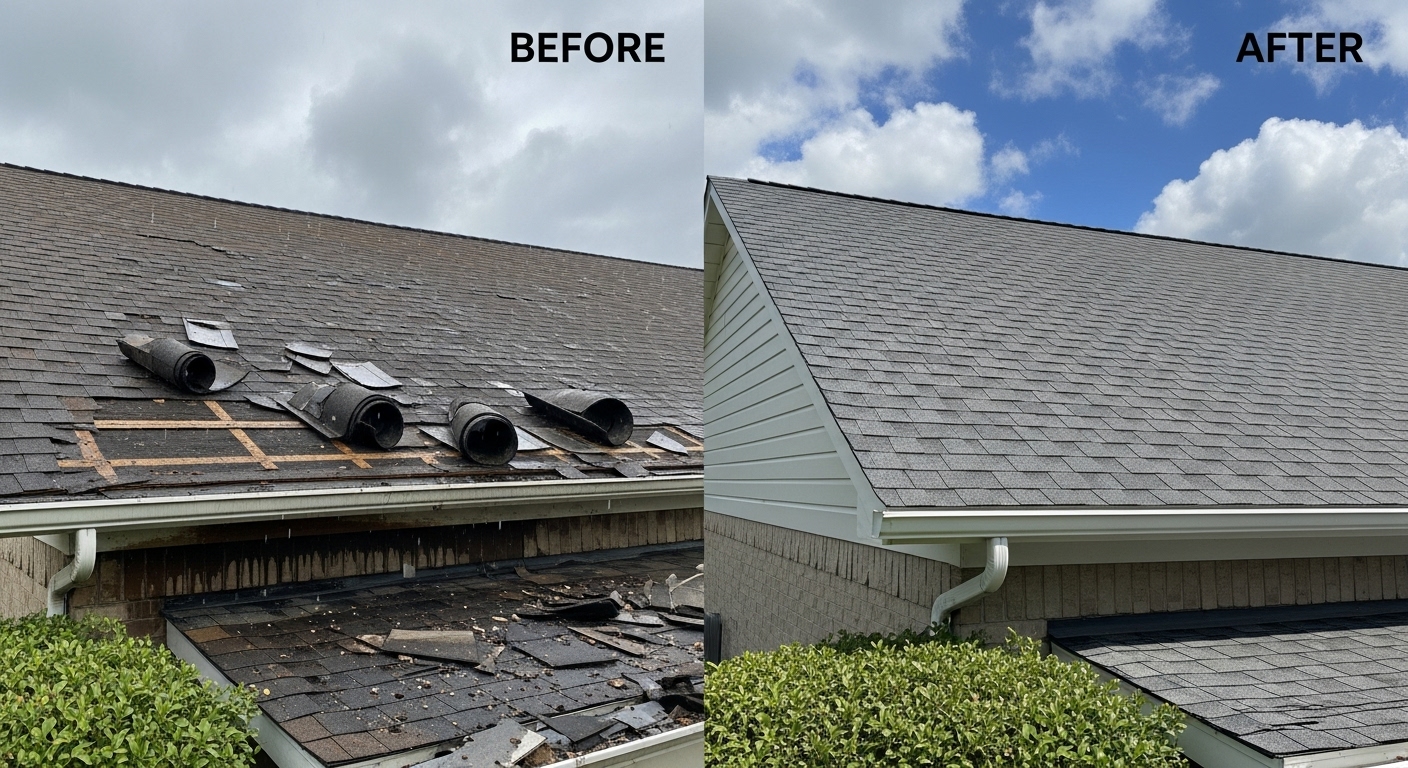
Before
- A recurring stain with an unclear cause
- A temporary patch without a long-term plan
- Uncertainty about the roof wood beneath the covering
- Confusion about who handles the ceiling
After
- An identified roofing issue and documented repair scope
- A defined permanent repair or replacement approach
- An explanation of accessible findings and any approved decking work
- Clear separation of roofing and interior-restoration responsibilities
How We Approach Roof Repairs and Replacement Materials
Compatible Components and Sound Installation Practices
A durable repair must suit the existing roof system and the condition beneath it. Replacing the visible covering without addressing an unsuitable substrate or failed transition can leave important problems unresolved.
The Proposed Method Should Address
- Compatibility with the existing roof material
- Flashing integration at walls, chimneys, and penetrations
- Condition of decking exposed within the approved scope
- Underlayment and water-management details appropriate to the project
- Fastening and installation requirements
- Drainage around affected low-slope areas
- Manufacturer instructions applicable to the chosen products
Temporary mitigation should be identified as temporary. Permanent roof work should have a defined scope rather than an open-ended promise that one treatment will solve every possible leak.
Can Your Water-Damaged Roof Be Repaired Instead of Replaced?
Choose Based on Condition, Extent of Damage, and Repair Feasibility
A localized defect may be repairable when the surrounding roof remains serviceable and suitable materials are available. Replacement may deserve consideration when damage or deterioration is widespread, several areas are failing, or repeated repairs no longer provide a sensible approach.
| Scenario | Repair May Be Appropriate | Replacement May Need Consideration |
|---|---|---|
| Isolated flashing defect | Surrounding materials are serviceable | Broader deterioration accompanies the defect |
| Limited covering damage | A compatible localized repair is feasible | Damage extends across substantial areas |
| Small affected decking area | The damaged area can be addressed locally | More extensive underlying damage is found |
| Repeated leaks | The unresolved source can be identified and corrected | Multiple failures indicate broader problems |
| Aging roof | Condition still supports an effective repair | Widespread deterioration limits useful repair options |
| Previous installation problems | A specific detail can be corrected | Defects affect substantial parts of the assembly |
When Replacement Warrants Discussion
- Damage extends beyond a practical localized repair
- Several roof areas show significant deterioration
- Available materials or assembly conditions limit a suitable repair
- The expected value of another repair is poor compared with a defined replacement project
Replacement decisions should consider the complete findings, not age alone.
How Much Does Roof Water Damage Repair Cost in Stafford?
A Property-Specific Estimate Is More Useful Than a Generic Price
The price depends on what is leaking, how difficult it is to reach, and what damage is discovered. A flashing repair and a replacement involving deteriorated decking are different projects.
Main Cost Drivers
- Roof height, pitch, layout, and access
- Material type and compatibility
- Size and location of the affected area
- Removal needed to investigate or complete the repair
- Decking or other wood repairs
- Temporary mitigation and scheduling requirements
- Disposal and separately included restoration work
| Service Type | Main Pricing Consideration |
|---|---|
| Leak inspection | Access and agreed investigation scope |
| Localized repair | Defect, material, and labor requirements |
| Flashing or penetration repair | Detail complexity and surrounding removal |
| Decking repair | Area exposed and replacement scope |
| Partial replacement | Assembly boundaries and material compatibility |
| Full replacement | Roof size, system, access, and underlying condition |
If concealed damage is exposed, the additional scope and cost should be explained before that work proceeds.
Which Signs Suggest Your Roof Needs Water-Damage Assessment?
Do Not Wait for the Next Storm to Explain a Returning Stain
You do not need to know the exact source before calling. Describing what you see and when it happens gives the inspection a useful starting point.
Arrange an Assessment When You Notice
- A ceiling stain that appears or grows after rain
- Dripping around a chimney, skylight, or vent area
- Damp insulation or visible water in an accessible attic
- Peeling finishes associated with recurring moisture
- Water entering near a roof-to-wall connection — see flashing repair
- A repaired area that leaks again
- Moisture problems following a replacement or addition
- Visible storm damage associated with new interior water intrusion
These symptoms justify investigation; they do not by themselves establish that full replacement is necessary.
Commercial Roof Water Damage Repair in Stafford County
Coordinate the Roofing Scope Around Tenants, Operations, and Access
Commercial roof leaks can affect occupied suites, stored materials, and daily operations. A useful proposal should identify the roofing scope while explaining access requirements, project sequencing, and responsibilities for related work.
For Northern Virginia roofing services involving commercial properties, describe the building use, roof access, affected areas, and operating constraints when requesting an assessment.
| Service | Project Focus |
|---|---|
| Roof leak assessment | Identify likely roofing defects and inspection limits |
| Localized repair | Address approved seams, penetrations, flashing, or covering defects |
| Partial or full replacement | Plan the appropriate roofing scope |
| Temporary mitigation | Limit water entry where suitable and safe |
| Condition documentation | Support owner records and project planning |
Commercial Property Inquiries Include
- Offices and retail buildings
- Mixed-use properties
- Apartment and multifamily buildings
- Community and institutional facilities
- Warehouses and managed commercial sites
Important Note
A ceiling leak in a business building is not always a roofing problem. Commercial plumbing leaks, HVAC condensate, and roof intrusion can produce overlapping symptoms; involve the appropriate trade when the evidence points beyond the roof.
| Project Type | Coordination Consideration |
|---|---|
| Occupied building | Access, noise, and protection planning |
| Multiple buildings | Phased assessments and scheduling |
| Restricted-access site | Entry procedures and work-area requirements |
Why Hire a Roofing Team for a Water-Damage Problem?
Diagnose the Cause Before Spending on the Wrong Repair
Professional assessment helps connect the visible symptom to the work actually needed. That is especially important when earlier repairs have failed or multiple possible moisture sources exist.
The objective is not to recommend the largest project. It is to explain an appropriate response to the conditions found.
What Should You Do if a Roof Leak Creates a Safety Concern?
Avoid Unsafe Roof Access and Stay Clear of Unstable Ceiling Areas
Safety comes first when water reaches electrical equipment, a ceiling begins to sag, or storm damage affects access to the building.
Do not climb onto a wet or storm-damaged roof to investigate. Keep people away from visibly unstable areas. If there is an immediate threat to occupants, leave the affected area and contact emergency services.
Important Safety Guidance
- Do not stand beneath a sagging or heavily saturated ceiling
- Avoid touching wet fixtures, outlets, or electrical equipment
- Move belongings only when the area is safe to enter
- Photograph damage from a safe position
- Arrange appropriate professional help rather than opening unsafe areas yourself
Water-Damaged Roof Repair & Replacement FAQs in Stafford, VA
Understand the Source, Scope, and Next Step
Does one roof leak mean I need a new roof?
No. A localized defect may be repairable. The recommendation depends on the roof's overall condition, the extent of damage, and whether a suitable repair is feasible.
Who should I call for a small roof leak?
Contact a roofing provider that offers leak assessment and localized repairs. Explain whether the leak is active, where it appears, and whether previous work has been performed. Our roof leak detection service can help identify the source.
Can a roof leak even when no shingles are missing?
Yes. Flashing, vent seals, skylight details, valleys, and other vulnerable areas can allow water entry without obvious missing shingles.
Is my ceiling leak coming from the roof or a pipe?
The timing and location provide clues, but neither proves the cause. Rain-related symptoms may point toward roof intrusion; moisture unrelated to rainfall may require plumbing, HVAC, or condensation investigation.
Does wet roof decking always need replacement?
Not automatically. The condition of the material matters. Deterioration, loss of integrity, and suitability as a substrate must be assessed rather than assuming every damp area needs the same treatment.
Should wet drywall be replaced or dried?
EPA guidance indicates drywall may be dried in place when there is no obvious swelling and seams remain intact; unsuitable or mold-affected materials require a different approach. The leak source and cavity moisture must also be addressed.
Does roof replacement include ceiling repairs?
Only if the written agreement includes them. Drywall, insulation, painting, mold work, and electrical repairs should not be assumed to be part of the roofing scope.
Why does the stain return after the roof was patched?
The original source may not have been corrected, another entry point may exist, or moisture may remain in affected materials. A repeat symptom calls for investigation rather than another cosmetic cover-up.
Can a roofer stop a leak while it is raining?
Some temporary measures may be possible, but access and safety govern the response. Permanent work may need suitable conditions and materials.
Does homeowners insurance cover roof leaks and ceiling damage?
Coverage depends on the policy, cause of loss, exclusions, deductibles, and claim findings. Contact your insurer; do not assume the roof and interior damage receive identical treatment.
Do I need a roofing permit in Stafford County?
Requirements depend on the building and scope. Ask Stafford County's Building Division about the proposed work, particularly when it includes damaged decking, framing, or other structural changes.
Who pays when a newly replaced roof leaks?
Responsibility depends on the cause, contract, warranty, and facts of the damage. Document the symptoms and contact the installing contractor promptly without assuming all subsequent damage is covered.
Know What Is Agreed Before Roofing Work Begins
Defined Scope, Practical Communication, and a Route for Follow-Up
Our commitment is to discuss your roofing concern, explain the proposed work, and make the project boundaries clear. Temporary mitigation, permanent repair, replacement, and interior restoration should not be confused with one another.
Reinforcing Statement
If a concern appears after completed work, contact Hart Staff Roofing with the affected location, photographs if available, and the relevant project information. Applicable written warranty terms determine the coverage and response.
Hart Staff Roofing
2834 Richmond HwyStafford, VA 22554
United States
Which Contractor Qualifications Matter for Roofing Work?
Licensing and Manufacturer Credentials Have Different Roles
Virginia contractor licensing distinguishes the license class from the classification or specialty. The class relates to project-value limits; the classification or specialty identifies the work permitted. ROC is the roofing contracting designation.
Relevant Credential Categories Include
- Virginia contractor license class
- Roofing contracting specialty
- Applicable residential or commercial classifications
- Manufacturer-specific installation credentials
- Training relevant to the roof system being proposed
A manufacturer credential is not the same as a contractor license, and neither replaces a clearly defined contract. Request the credential information relevant to your project as part of your contractor-selection process.
Emergency Roof Leak Help in Stafford, VA
Discuss Immediate Water Intrusion and Temporary Protection
An active leak needs a prompt conversation about conditions and next steps. Call Hart Staff Roofing if water is entering occupied areas, a temporary repair has failed, or storm damage has exposed part of the roof.
Emergency Response Begins With
- A phone discussion of the location and symptoms
- Identification of immediate occupant-safety concerns
- Assessment of access, conditions, and scheduling
- Discussion of suitable temporary mitigation
- Planning for inspection and permanent work
Urgent Scenarios Include
- Active water entry during or after rain
- Storm-related openings or damaged roof areas
- Water near fixtures or occupied workspaces
- A returning leak affecting already damaged materials
Temporary protection does not replace a permanent roofing scope, and on-site roof work must remain safe.
Roof Water Damage Insurance Documentation Support
Keep the Roofing Findings Separate From the Coverage Decision
When you report roof-related damage, useful records include photographs, a description of the symptoms, inspection findings, estimates, invoices, and temporary-repair receipts.
Virginia's insurance regulator advises homeowners to protect property from further damage, photograph conditions before cleanup where possible, and keep receipts. It also distinguishes emergency temporary repairs from final work the insurer may want to inspect first.
Documentation May Include
- Accessible damage photographs
- A description of observed roofing conditions
- Proposed repair or replacement scope
- Records of completed temporary work
- Approved additional-work details
- Final invoices and completion records
Policy Terms to Discuss
- Actual Cash Value (ACV)
- Replacement Cost Value (RCV)
- Recoverable depreciation
- Wind or hail deductibles
- Covered perils vs. wear and tear exclusions
Standard homeowners policies generally do not cover flooding; roof intrusion and ground-level floodwater should not be treated as the same event. Your insurer determines coverage. Roofing documentation does not guarantee payment.
Roof Repair and Replacement Warranty Information
Separate Workmanship Protection From Material Coverage
Warranty terms should describe what is covered, for how long, and how a concern is reported. A repair and a full replacement may have different coverage.
| Coverage Category | What to Review |
|---|---|
| Workmanship | Covered installation work, duration, exclusions, and remedy |
| Manufacturer materials | Product eligibility and applicable conditions |
| Registration | Any required submission or completion steps |
| Maintenance | Owner responsibilities relevant to coverage |
| Reporting | Contact procedure and supporting records |
| Consequential damage | Whether interior or related damage is included or excluded |
Keep your contract, invoices, product information, and applicable warranty documents together. Do not assume that every later leak, weather event, or interior stain falls within the warranty.
Five Equipped Service Vans Supporting Stafford Roofing Work
People and Vehicles Help Coordinate Inspection and Repair
Hart Staff Roofing's supplied business profile includes five equipped service vans and a team of 50 professionals. That capacity supports coordination across inspections, repair work, and larger roofing projects.
The Equipment Needed Depends on the Job
- Safe access appropriate to the building
- Tools suited to the roof material and repair detail
- Materials selected for the approved scope
- Protection and cleanup arrangements
- Additional resources for larger removal or replacement work
A stocked vehicle does not mean every leak can be permanently repaired in one visit. Material availability, access, weather, and concealed damage can affect the project sequence.
Payment Options for Larger Roof Repair and Replacement Projects
Compare the Project Cost and the Payment Terms Separately
When a roof needs more extensive work, payment planning can be part of the estimate discussion. Ask about any currently available financing or payment arrangements for the proposed project.
Before Choosing an Option, Review
- Eligibility and approval requirements
- Interest rates and promotional periods
- Payment timing
- Fees and any deferred-interest conditions
- Total repayment cost
- Whether the offer applies to your project
A "no interest" or "no payments" headline is not a substitute for the full agreement. Financing and anticipated insurance reimbursement are separate considerations.
Look Beyond Roofing Awards to the Details of Your Project
Experience, Scope, and Follow-Through Matter Together
Industry and community recognition can be useful background, but your project still needs an appropriate inspection, clear scope, and understandable terms.
Recognition Categories Customers May Encounter Include
- Local readers' choice awards
- Service-platform awards
- Contractor-association recognition
- Manufacturer contractor designations
- Manufacturer installation or service awards
For your roof, the most useful evidence is a clear explanation of the condition and how the proposed work addresses it.
Community Discounts for Qualifying Roofing Projects
Understand Eligibility Before Comparing Estimates
Customers interested in the Hometown Heroes community offer can ask about current availability and project eligibility when requesting an estimate. Senior customers can also inquire about any applicable current offers.
Offer Considerations Include
- Eligible customer groups
- Qualifying repair or replacement work
- Discount amount or calculation
- Minimum project requirements
- Excluded items
- Whether offers can be combined
Current Hart Staff Roofing Community Offers
- The "Complimentary Tune-Up" Assessment Bundle
- The "Hometown Heroes" Community Discount
- The "No Interest, No Payments" Financing Promo
- The "Roof & Gutter Combo" Discount
- The "Tiered Project Value" Markdown
Any applicable discount should appear clearly in the written proposal. Compare the full scope and final price rather than assuming a promotional label makes two estimates equivalent.
Hart Staff Roofing Emergency Contact Hours
Around-the-Clock Contact With Project-Specific Scheduling
Our emergency contact is available seven days a week. Scheduled assessments and roofing work are coordinated according to the project, safe access, weather, and availability.
| Day | Emergency Contact Availability |
|---|---|
| Monday | 24 hours |
| Tuesday | 24 hours |
| Wednesday | 24 hours |
| Thursday | 24 hours |
| Friday | 24 hours |
| Saturday | 24 hours |
| Sunday | 24 hours |
When calling, explain whether the leak is active and mention any immediate safety concern.
How to Compare Stafford Roof Repair Providers
Ask the Same Questions Before Choosing a Contractor
Two proposals may describe very different work. One might include removal and flashing reconstruction; another might cover only a surface treatment. A lower number is difficult to evaluate without understanding that difference.
| Feature | What to Discuss with Hart Staff Roofing | What to Ask Any Provider |
|---|---|---|
| Leak diagnosis | Findings and inspection limitations | What supports the proposed repair? |
| Repair versus replacement | Basis for the recommendation | Why is this scope appropriate? |
| Materials | Compatibility and specified products | What will be installed? |
| Concealed damage | Additional-work approval process | How are wood repairs priced? |
| Interior restoration | Included work and exclusions | Who handles ceilings and insulation? |
| Availability | Contact and scheduling expectations | What response is actually promised? |
| Warranty | Applicable written terms | What is covered and excluded? |
| Documentation | Estimate, work records, and invoices | What records will I receive? |
Choose the proposal that explains the work clearly and addresses the identified condition.
Contact Hart Staff Roofing for Water-Damaged Roof Repairs in Stafford
Tell Us What You See, When It Happens, and Where Water Appears
You do not need to diagnose the roof before contacting us. Tell us whether you have an active drip, a recurring ceiling stain, damp attic materials, or a leak that returned after earlier work.
Hart Staff Roofing can discuss an assessment, immediate mitigation needs, and repair or replacement options. Include your property address, building type, affected area, and any previous repair information so the conversation starts with useful details.
Contact Hart Staff Roofing
+1 (540) 930-6660
hartstaffroofing@gmail.com
2834 Richmond Hwy
Stafford, VA 22554, USA
Water Damage Roof Repair & Replacement
24/7 Emergency Service Available
Get a practical next step for water damage roof repair and replacement in Stafford, VA, with Hart Staff Roofing.
Water Damage Roofing Service Area Coverage
Our team serves Alexandria, Arlington, McLean, Reston, and all of Stafford County.