Chimney Flashing Repair & Replacement in Stafford, VA
Northern Virginia Chimney Flashing Roof Repair for Homes, Businesses & Managed Properties
When you need chimney flashing roof repair in Stafford, VA, you need more than another layer of caulk around the chimney. You need the source of the water entry investigated, the surrounding roofing assessed, and a repair plan that explains what will be corrected.
Hart Staff Roofing helps homeowners, landlords, HOAs, and commercial property managers address chimney-area roof leaks, deteriorated flashing, and repairs that have not held up through the next rainfall. Established in 2010, our business brings a team of 50 skilled professionals and five equipped service vans to roofing work throughout Stafford County and surrounding service areas.
Whether you have water dripping beside the fireplace or want to replace damaged flashing before the next storm, start with a clear conversation about the problem—not an automatic recommendation for a new roof.
- Chimney-to-roof flashing assessment for residential and commercial properties
- Repair and replacement options based on the condition of the assembly
- Clear explanations of shingles, underlayment, decking, and related work
- Around-the-clock contact for urgent roof-leak concerns
Call for help with an active leak, inspection scheduling, or a written repair estimate. Emergency assistance is available 24/7; exterior work depends on safe access and weather conditions.
Request Chimney Flashing Repair
Fill out the form and we'll contact you immediately!
Chimney Leak Repair in Stafford, VA, Backed by Practical Roofing Experience
Clear Findings, Defined Repair Scope & Straightforward Communication
A chimney leak can be frustrating because the visible stain does not always reveal where water entered. Damaged flashing is one possible cause, but chimney caps, chase covers, masonry defects, and other chimney issues can also contribute to moisture problems.
Hart Staff Roofing approaches the work with a simple priority: understand the roof-to-chimney connection before recommending how to repair it. We explain what is visible, what may require opening the surrounding roofing, and which findings could involve a chimney or masonry specialist.
You should know what the proposed work covers, what remains outside the estimate, and how additional damage will be handled.
- Established in 2010 and based in Stafford
- A team of 50 skilled professionals supporting roofing projects
- Five equipped service vans for local service operations
- Residential, commercial, and managed-property roofing services
- 24/7 emergency contact availability
- Repair recommendations tied to the observed condition—not a one-size-fits-all patch
Chimney Flashing Repair Near Stafford Neighborhoods, Landmarks & Business Corridors
Serving Properties Around Stafford Courthouse, Garrisonville & Aquia Harbour
Whether your property is near Government Island, along Richmond Highway, or in an established Stafford County community, our first concern is the same: identifying how the chimney penetration interacts with the surrounding roof.
Hart Staff Roofing serves homeowners and property managers across communities including Aquia Harbour, Garrisonville, Embrey Mill, Hampton Oaks, Colonial Forge, Augustine, Falmouth, and the Stafford Courthouse area. Share your address when you call so we can discuss coverage, access, and scheduling for your property.
For owners who commute or manage properties remotely, clear photographs and an explained scope can make repair decisions easier without requiring you to climb onto the roof.
- Stafford County communities: Austin Ridge, Autumn Ridge, Park Ridge, Potomac Hills, Vista Woods, Woodstream, and other listed service communities
- Surrounding service areas: Alexandria, Arlington, Centreville, Leesburg, McLean, and Reston
- Familiar local destinations: Aquia Episcopal Church, Government Island, Aquia Landing Park, and Stafford Civil War Park
- Property access considerations: gates, shared driveways, HOA procedures, tenant coordination, and safe equipment placement
A location reference helps describe coverage; every estimate remains specific to the actual property and repair needs.
Specialized Repairs for Step Flashing, Counterflashing & Chimney Roof Transitions
Roofing Details That Work Together to Direct Water Away
The metal around a chimney is not simply decorative trim. Base flashing, step flashing, and counterflashing must overlap and integrate with the roofing so rainwater drains outward rather than entering the roof assembly. Building America guidance describes this layered relationship between flashing, shingles, underlayment, and masonry.
A repair that addresses only visible sealant may leave an underlying problem untouched. We evaluate the condition and arrangement of the components before deciding whether a targeted repair or broader reconstruction makes sense.
Our service focuses on:
- Flashing-to-shingle integration
- Counterflashing overlap and attachment
- Corners, joints, and exposed penetrations
- Upper-side drainage behind the chimney
- Adjacent roofing and accessible signs of moisture damage
- Identifying when masonry, crown, cap, or flue concerns need separate attention
If both roofing and chimney defects are present, the repair plan should identify each responsibility rather than leaving you between two trades.
Why Is Your Roof Leaking Around the Chimney in Stafford?
Common Symptoms—and Why the Visible Stain May Not Tell the Whole Story
Water can enter where flashing is damaged or incorrectly installed, but moisture near a chimney can also originate from deteriorated mortar, a damaged cap or chase cover, or other chimney defects. Repairing the wrong component can leave the original problem unresolved.
Call for an assessment when you notice:
- A ceiling stain beside the fireplace or chimney
- Damp wood or insulation near the chimney in the attic
- Dripping that appears during heavy or wind-driven rain
- Loose, separated, or visibly deteriorated metal
- Cracked sealant or thick layers of old roof tar
- A leak that returns after previous repair work
Repeated water entry can affect nearby roof materials, attic surfaces, and interior finishes. The priority is to identify and stop the entry point while assessing related damage—not merely repaint the stain.
Important: A leak that stops when the rain ends still deserves attention. Intermittent symptoms do not establish that the underlying defect has corrected itself. Call (540) 930-6660 for a professional roof inspection.
Prevent Recurring Chimney Leaks with Planned Roof-Flashing Inspections
Know What Is Being Inspected—and What the Inspection Does Not Certify
A periodic flashing inspection can help identify visible deterioration, debris accumulation, and developing defects before they become an active interior leak. Inspection timing should reflect your roof's condition, exposure, repair history, and any applicable maintenance requirements.
A roof-flashing assessment is separate from chimney cleaning, flue inspection, and fireplace-use safety evaluation. A chimney professional may be needed for those services.
| Maintenance Task | What It Addresses | Useful Timing | Practical Benefit |
|---|---|---|---|
| Visual flashing assessment | Accessible metal, overlaps, joints, and sealant condition | Planned inspection or after a reported concern | Identifies visible defects |
| Surrounding roof review | Nearby shingles and roof-transition details | During the flashing assessment | Helps define related work |
| Upper-side drainage check | Debris and drainage around the chimney | When safely accessible | Identifies obstructions or detailing concerns |
| Interior moisture review | Accessible staining or dampness | When a leak is reported | Helps document affected areas |
| Photographs and findings | Observed conditions and recommended next steps | At assessment and completion | Gives owners a useful record |
| Repair planning | Scope, options, and exclusions | When defects are identified | Supports informed decisions |
Plan an inspection:
- Before coordinating a larger roof project
- After new chimney-area staining appears
- When an earlier repair has failed
- After a storm if new damage is suspected
There is no single flashing-service frequency appropriate for every property. Costs depend on access, investigation scope, and any additional work requested.
Keep prior estimates, repair photographs, invoices, and warranty documents together. They can help explain what has already been attempted.
Schedule a Chimney Flashing InspectionWho Can Benefit from Chimney Flashing Repair in Stafford County?
Homeowners, Landlords, HOAs & Commercial Property Managers
Hart Staff Roofing works with owners and managers who need roofing problems explained clearly and repairs coordinated responsibly. A chimney penetration may serve a single home, a shared building, or a commercial property, but the repair must fit the actual roof and chimney construction.
We help:
- Homeowners dealing with stains, drips, or deteriorated flashing
- Landlords arranging access and repairs for occupied properties
- HOA representatives coordinating owner and association responsibilities
- Multifamily managers addressing relevant roof penetrations
- Commercial owners assessing chimney-area water entry
- Buyers or sellers seeking a defined repair scope after an inspection finding
Tell us who authorizes the work, who needs the estimate, and whether tenants or other occupants need advance notice.
How Weather and Roof Conditions Can Reveal Chimney-Flashing Defects
A Leak During One Storm but Not Another Still Needs Investigation
A chimney-area leak may appear only under particular conditions. Roof pitch, water flow, wind direction, flashing details, and the condition of nearby materials can influence when moisture becomes visible.
Rather than assuming every Stafford property faces the same problem, we ask what you have observed: when the leak starts, how long it lasts, and whether recent work changed the symptoms.
Spring
Inspect reported leaks and visible defects rather than assuming winter exposure caused them.
Summer
Note whether heavy rainfall or wind-driven rain triggers moisture.
Fall
Assess debris accumulation and drainage behind the chimney.
Winter
Plan inspections and repairs around safe access, surface conditions, and material requirements.
Where roof slopes meet the upper side of a masonry chimney, a properly designed cricket or saddle can redirect runoff around the obstruction. Its suitability depends on the roof and chimney configuration.
The goal is not to blame the season. It is to understand why water is reaching a vulnerable detail.
Which Chimney-Flashing Components Protect the Roof Joint?
Step Flashing, Counterflashing, Aprons, Back Pans & Crickets Explained
Different roof and chimney assemblies use different details. Knowing the terminology makes it easier to understand an inspection report and compare repair estimates.
| Component | Typical Position | Primary Purpose | What Needs Attention |
|---|---|---|---|
| Front or apron flashing | Downhill face of the chimney | Directs water onto the roofing below | Integration, joints, and condition |
| Step flashing | Sides of a chimney alongside shingle courses | Layers the roof-to-chimney transition | Overlap and shingle integration |
| Counterflashing | Above base or step flashing | Protects the upper flashing edge | Attachment, overlap, and termination |
| Back pan | Uphill side | Handles runoff behind the chimney | Drainage path and connections |
| Cricket or saddle | Upslope of the chimney where applicable | Diverts approaching roof runoff | Configuration and flashing integration |
| Underlayment | Beneath the roofing around the penetration | Provides a supporting water-management layer | Condition and continuity when exposed |
For masonry construction, counterflashing may be embedded into mortar joints and overlap the base and step flashing. The complete arrangement—not one isolated piece—creates the transition.
A framed chimney chase requires attention to its own cladding and roof-transition details. The repair should match the construction you actually have.
Our 6-Step Chimney Flashing Roof Repair Process
Know What Happens Before, During & After the Repair
Initial Call & Symptom Review
We discuss your property location, visible moisture, when the leak occurs, and any previous repairs. Photographs can help prepare for the visit but do not replace an on-site assessment.
Safe Access & Inspection Planning
We consider roof height, pitch, surface conditions, equipment placement, and access to relevant interior areas.
Flashing & Leak-Source Assessment
We examine accessible roofing details and visible chimney conditions. If additional investigation is needed, we explain its purpose and limitations.
Written Findings & Repair Options
The proposed scope identifies the work, materials, exclusions, and how hidden damage would be handled.
Approved Repair or Replacement
Work proceeds according to the agreed scope, with additional findings discussed before expanding the project.
Completion Documentation & Follow-Up
We review the completed work, applicable care instructions, and any project-specific warranty or follow-up terms.
A clear process prevents "seal the chimney" from becoming a substitute for an explained repair.
What Is Included in Chimney-Flashing Inspection, Repair or Replacement?
Separate the Assessment from the Approved Construction Work
The scope depends on the service you authorize. An assessment does not automatically include dismantling the roof, replacing flashing, repairing masonry, or restoring interior finishes.
Your written proposal should identify the relevant deliverables:
- Symptom and previous-repair review
- Accessible visual assessment
- Photographs or explained findings
- The specific flashing components being repaired or replaced
- Removal and disposal requirements
- Shingle and underlayment work, where included
- Decking repairs, if included or separately priced
- Material specifications
- Cleanup and completion review
- Applicable warranty terms
If damaged wood becomes visible after roofing is opened, the additional work should be described and authorized through the agreed change-order process.
Note: Chimney masonry, fireplace systems, wet insulation, mold assessment, electrical work, and interior decoration may require separate services. Your estimate should make those boundaries clear.
Clear Scope, Repair Documentation & Coordinated Roofing Support
Less Guesswork for Owners Making an Important Decision
The strongest service features are the ones that help you understand what is happening at your property.
Hart Staff Roofing emphasizes:
- A symptom-first conversation
- A defined assessment and repair scope
- Explanations of the flashing components involved
- Clear handling of additional findings
- Photographs that support the repair discussion
- Coordination with broader roofing work when needed
- A contact route for questions after the project
For landlords and managers, the same information can support approvals, owner communication, and maintenance records.
A large team is useful only when the work remains well coordinated. You should know who is communicating the findings and how decisions reach the repair crew.
What Should Change After Chimney Flashing Work?
Visible Workmanship, Clear Records & a Defined Follow-Up Plan
A useful before-and-after record should do more than show fresh metal. It should explain the observed defect and the work performed.
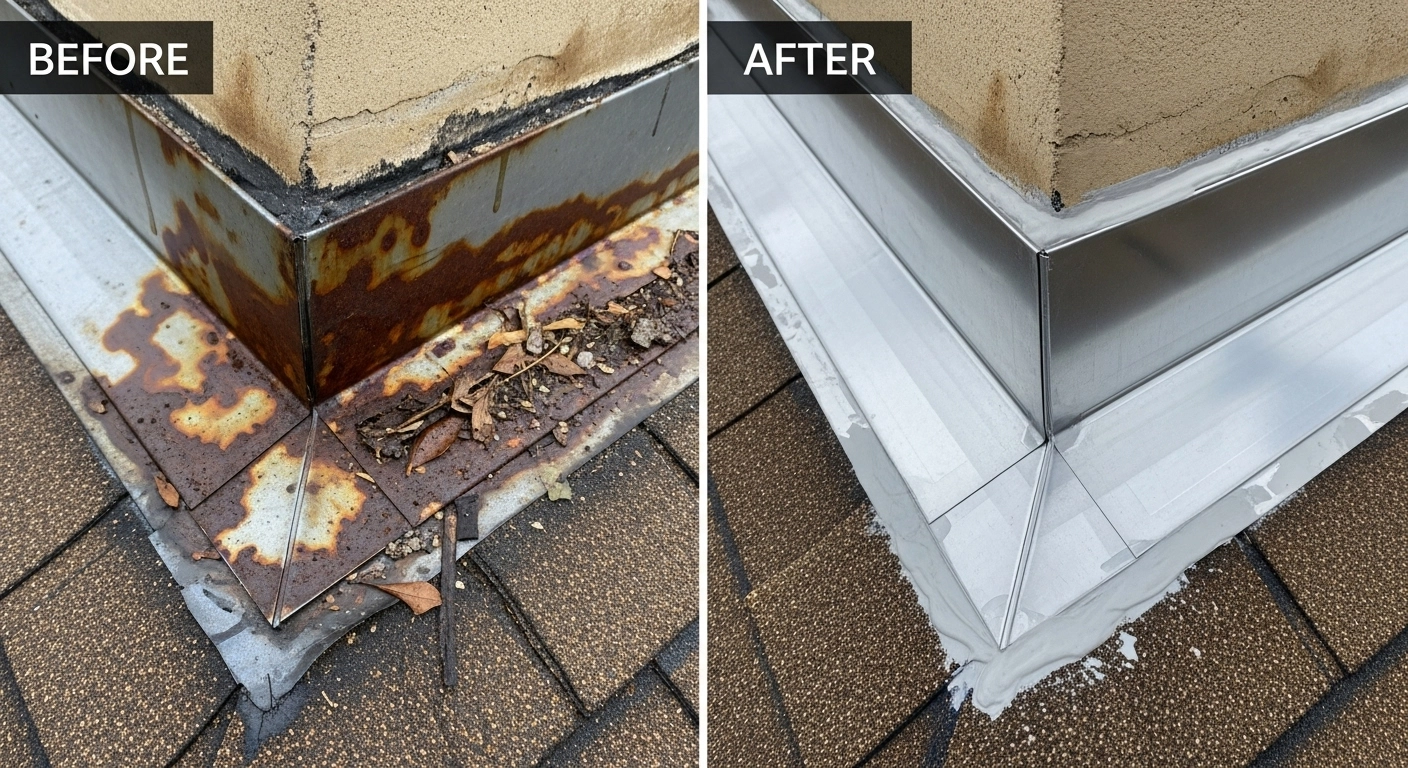
For your project, ask for documentation that shows:
Before
Deteriorated sealant or visible separation
After
The approved repair detail and how it connects to surrounding roofing
Before
Uncertain scope or layers of previous patching
After
A record of what was removed, retained, and replaced
Before
Concern about hidden damage
After
Documentation of exposed findings and approved additional work
Before
Uncertainty about future support
After
The relevant workmanship terms and reporting procedure
Photographs document visible conditions. They should be paired with a written scope rather than treated as a guarantee that no unrelated leak can occur.
How We Approach Chimney-Flashing Installation and Replacement
Proper Integration Matters More Than Covering the Joint with Sealant
A durable repair requires attention to the way water moves across the roofing and around the chimney. Depending on the project, work may involve removing nearby shingles, assessing exposed decking, renewing underlayment, and installing flashing that integrates with the roof assembly.
Material and method decisions include:
- Flashing metal compatible with the surrounding assembly
- Appropriate detailing for the roof material and chimney construction
- Correctly layered step flashing
- Counterflashing termination and overlap
- Upper-side runoff management
- Suitable sealants used in their intended role
- Treatment of damaged adjacent materials
Important distinction: A repair coating and full reflashing are different services. Product demonstrations show coating systems applied to existing flashing, while reconstruction involves shingles, decking, underlayment, and new metal details. The estimate should tell you which approach is proposed and why. Surface sealing should not conceal a defect that requires reconstruction.
Can Chimney Flashing Be Repaired, or Does It Need Replacement?
Avoid Both Unnecessary Replacement and Repeated Short-Term Patching
Some defects are localized. Others involve deteriorated metal, incorrect integration, or damage beneath the roofing. The appropriate decision comes from the assessment—not a rule that every chimney leak needs a complete rebuild.
| Finding | Targeted Repair May Be Suitable When | Replacement May Be Appropriate When |
|---|---|---|
| Localized sealant defect | Surrounding flashing is sound and properly detailed | The visible defect is part of broader deterioration |
| Loose or damaged component | A limited correction restores the intended assembly | Multiple components are damaged or incorrectly arranged |
| Repeated leakage | A specific isolated entry point is identified | Previous patches have not addressed the underlying detail |
| Metal deterioration | Damage is limited and repairable | The metal is extensively compromised |
| Roofing opened for other work | Existing components remain suitable | Integration or condition warrants new flashing |
| Hidden damage | Adjacent materials remain serviceable | Damaged decking or roofing expands the necessary scope |
Replacement deserves consideration when the assembly is extensively deteriorated, improperly constructed, or repeatedly patched without resolving the identified flashing defect.
A flashing replacement does not automatically require a whole-roof replacement. The surrounding roof's condition and the work needed to integrate the repair determine the extent.
How Much Does Chimney-Flashing Repair Cost in Stafford, VA?
Compare Scope, Materials, Access & Exclusions—Not Just the Total
There is no dependable single price for every chimney. A limited repair on an accessible roof is a different project from custom flashing replacement on a steep roof with damaged decking.
Your estimate should account for:
- Roof height, pitch, and safe access
- Roof material and the work needed around the chimney
- Chimney size and construction
- Flashing material and fabrication
- Removal of existing flashing or patching
- Shingle and underlayment replacement
- Exposed decking damage
- Related masonry needs
- Temporary mitigation versus permanent repair
| Service Type | What Influences the Estimate |
|---|---|
| Inspection or leak assessment | Access, investigation scope, and service terms |
| Targeted flashing repair | Location and extent of the identified defect |
| Full flashing replacement | Removal, materials, fabrication, and integration |
| Associated decking repair | Extent and condition of exposed wood |
| Roof-and-flashing project | Broader roofing scope and shared work |
| Emergency mitigation | Conditions, access, and temporary measures |
Ask whether disposal, adjacent roofing, hidden damage, and cleanup are included. A lower quote may cover less work; a higher quote should still explain its scope.
Insurance contributions and financing eligibility are separate from the contractor's repair price.
Request a Chimney-Flashing Repair EstimateWhen Should You Arrange a Chimney-Flashing Assessment?
Active Leaks, Visible Defects & Repairs That Have Not Held Up
You do not need to wait for steady dripping before asking about the chimney-to-roof connection.
Arrange an assessment when:
- New moisture appears beside the chimney
- The attic is damp around the penetration
- Flashing looks separated, damaged, or deteriorated
- Old tar or sealant is peeling
- The same leak returns after a repair
- New roof work is followed by chimney-area leakage
- A property inspection identifies flashing concerns
- Roof replacement is being planned around an existing chimney
These are reasons to investigate—not proof that flashing is the only problem.
If you see a new stain, record when it appeared and whether rain, wind, or recent work preceded it. That history can help guide the assessment.
Commercial Chimney-Flashing Repair for Stafford Property Managers
Coordinate Access, Approvals & Building Operations
Commercial properties need the same clear diagnosis as homes, with additional attention to occupancy, access, and authorization.
Hart Staff Roofing works with owners, facility managers, and property representatives to define relevant roof-penetration repairs and coordinate them with the building's operations.
| Commercial Service | Scope |
|---|---|
| Chimney-area leak assessment | Review accessible conditions and reported symptoms |
| Targeted flashing repair | Correct an identified localized defect |
| Flashing replacement | Rebuild the specified roof-to-chimney detail |
| Related roofing work | Address approved adjacent materials |
| Maintenance planning | Record findings and coordinate future attention |
Relevant properties may include:
- Multifamily buildings with chimney penetrations
- Office or mixed-use properties
- Hospitality buildings
- Churches and community facilities
- Commercial buildings with applicable chimney or masonry roof transitions
Commercial plumbing leaks, roof-drain problems, and chimney-flashing leaks are different issues. If the moisture source is uncertain, the investigation should distinguish them rather than treating every ceiling leak as a roofing defect.
| Planning Consideration | What to Establish |
|---|---|
| Occupied property | Access times and occupant communication |
| Managed portfolio | Authorized contacts and documentation format |
| Restricted site | Entry procedures and equipment placement |
| Larger roof project | Sequencing and related work |
| Additional findings | Approval and change-order procedures |
Why Professional Chimney-Flashing Repair Matters
Safer Access, Defined Work & Better Coordination
Professional service should provide more than a fresh-looking patch. It should help you understand the defect, the proposed correction, and the limits of the work.
Benefits include:
- Assessment of the roof-to-chimney detail rather than assumptions from a stain
- Repair options tied to observed conditions
- Integration with surrounding roof materials
- Planning for access and weather limitations
- Documentation of approved work
- Identification of concerns that require another specialist
- Clearer expectations about follow-up and warranties
Where flashing is responsible for leakage, timely repair can help limit continued water exposure to nearby building materials. Existing damage may still need separate attention.
The objective is an appropriate repair—not simply the largest project or the quickest surface treatment.
Do Not Climb onto a Wet Roof to Find the Leak
Why DIY Chimney-Flashing Work Can Create Additional Risk
Wet surfaces, high winds, ice, roof pitch, and deteriorated materials can make roof work hazardous. OSHA identifies wet weather, high winds, and icy conditions as particular dangers for roofing workers and advises considering suspension of operations in bad weather.
For an active leak:
- Stay off the roof and avoid exterior ladder inspection
- Keep people away from sagging or unstable ceiling areas
- Move belongings only where it is safe to do so
- Keep clear of wet electrical fixtures or equipment
- Photograph visible interior symptoms from a safe location
- Contact appropriate emergency services if there is an immediate electrical or structural hazard
Warning: Do not puncture a swollen ceiling or disturb unstable materials. An urgent leak does not justify an unsafe attempt to access the roof. A roof-leak repair also does not certify that a fireplace or flue is safe to operate. Separate chimney-system concerns need appropriate inspection.
Chimney Flashing Roof Repair FAQs for Stafford Property Owners
Leak Sources, Repair Options, Costs & Contractor Responsibilities
Active water entry deserves prompt attention. The immediate response depends on the amount of water, affected materials, electrical concerns, and safe access. Contact us rather than waiting for the stain to become larger.
No. Flashing, masonry, caps, chase covers, and other chimney issues can contribute to moisture. The source should be assessed before work is recommended.
Yes, leakage can be intermittent. Record the weather conditions and where water appears so the assessment can consider the reported pattern.
Often the work can be limited to the chimney area, but the surrounding roofing condition and integration requirements determine the scope. Learn more about our roof replacement services.
Sealant can serve a legitimate role, but it does not automatically correct damaged metal, inadequate overlaps, or an improperly built assembly. The underlying condition matters.
The original source may remain unresolved, the scope may have been incomplete, or a separate chimney defect may be contributing. A reassessment should examine the prior work without assuming the cause. Call (540) 930-6660 for a leak detection assessment.
A roofer generally addresses the roof flashing and surrounding roofing. Masonry deterioration, crowns, and other chimney-system concerns may require a chimney or masonry specialist. Some properties need coordinated work.
The proposed construction method should explain what is removed, retained, and why. Do not assume covering existing material is suitable without assessing its condition and the resulting detail.
The damaged area should be documented and the additional scope discussed through the agreed authorization process. Your estimate should explain how hidden damage is priced.
The roof and chimney configuration determine the appropriate drainage detail. A cricket or saddle redirects upslope runoff around the chimney; it is not a substitute for correctly integrated flashing.
Look for removal details, material specifications, adjacent roofing work, exclusions, disposal, hidden-damage procedures, and warranty terms.
Hart Staff Roofing offers 24/7 emergency contact availability. Safe access, weather, and actual scheduling determine when exterior work can proceed. Call (540) 930-6660 anytime.
Know What Your Chimney-Flashing Repair Is Intended to Address
Defined Scope, Completion Review & Project-Specific Support
Our approach is straightforward: explain the findings, describe the approved work, and make the repair responsibilities clear.
Your agreement should identify the repair area, materials, exclusions, and applicable workmanship terms. If moisture returns, report it promptly with photographs and the conditions under which it appeared.
A recurring symptom needs reassessment; it should not be dismissed or automatically attributed to the same source. Any corrective work and charges depend on the findings and the applicable agreement.
Hart Staff Roofing
2834 Richmond Hwy
Stafford, VA 22554
United States
Roofing Qualifications and Chimney-Flashing Repair
Contractor Licensing, Project Scope & Manufacturer Credentials
Roofing and chimney work should be evaluated according to the actual work being contracted. Virginia identifies roofing contracting as ROC, covering relevant roof-system materials and components; other listed building classifications and specialties can also provide for roofing functions.
When discussing your project, ask about:
- The contracting entity and applicable license information
- Authorization for the proposed roofing scope
- Any separate masonry or chimney-system work
- Manufacturer credentials relevant to the materials being used
- Insurance documentation required for your property
- Written workmanship and material terms
Roofing contractor classifications and manufacturer designations are not interchangeable. Likewise, a manufacturer's credential does not mean every standalone flashing repair carries the same warranty as a qualifying roof-system installation.
We welcome questions about the qualifications and project documents relevant to your estimate.
Emergency Chimney Leak Assistance in Stafford, VA
Immediate Communication, Safe Mitigation & Permanent-Repair Planning
Call (540) 930-6660 when water is entering around the chimney. Tell us whether the leak is active, where moisture is visible, and whether ceilings, fixtures, or electrical equipment are affected.
Emergency assistance may involve:
- Telephone discussion of the visible symptoms
- Assessment of urgency and scheduling
- Safe-access planning
- Temporary mitigation where suitable
- Inspection and permanent-repair recommendations
- Documentation of observed damage
Common reasons to call include:
- Active dripping near the chimney
- Sudden moisture after a storm
- Visibly displaced flashing
- A recurring leak after earlier work
- Water affecting occupied rooms or business operations
Temporary protection is not necessarily the completed repair. We explain the next step rather than presenting short-term mitigation as a universal permanent solution.
Call 24/7 Emergency: (540) 930-6660Documentation Support for Chimney-Area Roof Damage
Clear Photos, Findings, Scope & Invoices
If you are discussing damage with your insurer, organized repair documentation can help explain the observed condition and proposed work.
Relevant records may include:
- Photographs of accessible damage
- Inspection notes
- The itemized repair estimate
- Additional findings documented during work
- Approved change orders
- Completion photographs and invoices
Insurance treatment depends on your policy and the cause of loss. Do not assume that deteriorated flashing, poor prior workmanship, or every rain-related leak is covered.
Actual cash value accounts for depreciation, while replacement-cost provisions operate according to the policy's terms and conditions. Virginia's insurance guide explains actual cash value as replacement cost less depreciation for age and normal wear.
Note: Ask your insurer about deductibles, depreciation, covered perils, exclusions, and documentation requirements. Hart Staff Roofing's repair scope does not determine claim approval.
Chimney-Flashing Workmanship and Material Warranty Considerations
Understand the Covered Area, Duration & Reporting Procedure
Warranty protection should be stated in writing for the project—not inferred from a general promise.
| Coverage Area | What to Understand |
|---|---|
| Workmanship | Duration, covered work, and corrective-service terms |
| Materials | Any applicable manufacturer coverage |
| Repair boundaries | Which flashing or roof areas were included |
| Exclusions | Unrelated defects, later alterations, or other stated limitations |
| Reporting | How and when to notify the contractor |
| Transfer | Whether coverage applies after ownership changes |
Keep the estimate, agreement, photographs, and invoice together.
If you report a leak after the repair, include when it occurred and where moisture appeared. A follow-up assessment can distinguish a covered workmanship issue from an unrelated defect or work outside the original scope.
Do not assume that new flashing also warranties the chimney cap, masonry, entire roof, or interior finishes.
Five Equipped Service Vans Supporting Stafford Roofing Projects
Tools and Access Planning Matched to the Work
Hart Staff Roofing's five equipped service vans support inspection, repair, and project coordination across our service areas.
The equipment needed depends on roof access, material, height, and the proposed scope. Some repairs require custom metal preparation, specialized access arrangements, or additional materials.
Project planning considers:
- Appropriate roof-access and safety equipment
- Inspection and documentation tools
- Metal-detail and installation requirements
- Materials for the approved roofing work
- Waste handling and cleanup
- Additional resources for larger or restricted-access sites
Vehicle availability does not replace proper scheduling. We discuss what your project requires rather than promising every repair can be completed in a single visit.
Payment and Financing Questions for Chimney-Flashing Replacement
Understand Eligibility, Costs & Terms Before Making a Decision
A localized repair and a larger roofing project can have very different payment requirements. Ask which payment options apply to your estimate and whether financing is available for the size and type of work proposed.
Before accepting an offer, understand:
- Any minimum project amount
- Credit approval requirements
- Interest and promotional periods
- Deferred-interest conditions, if applicable
- Payment dates and fees
- Whether the promotion combines with other offers
A "no interest" or "no payments" promotion should be evaluated by its complete terms, not only its headline.
Do not let financing language obscure the repair scope. First understand the work; then compare the payment options.
Evaluate Service Recognition Alongside the Repair Proposal
The Details of Your Job Remain the Most Important Evidence
Awards, contractor designations, and community recognition can help introduce a roofing business. They do not explain which component is leaking or what your estimate includes.
When evaluating Hart Staff Roofing, consider:
- The clarity of the inspection findings
- The proposed flashing details
- Material and removal specifications
- Relevant project documentation
- Communication about additional damage
- Applicable workmanship terms
Recognition categories you may encounter include local service awards, customer-service awards, and manufacturer contractor programs. These are different forms of recognition and should not be treated as identical qualifications.
Choose your repair based on the documented work proposed for your property—not a collection of award names alone.
Chimney-Flashing Repair Offers for Eligible Stafford Customers
Clear Eligibility and Written Savings Terms
If you are a military member, veteran, first responder, senior homeowner, or another customer seeking a community offer, ask which current promotions apply to your project.
For any quoted discount, understand:
- Who qualifies
- Which services are eligible
- Whether there is a minimum project value
- Whether materials or emergency work are excluded
- Whether offers can be combined
- When the offer expires
Ask about any available Hometown Heroes promotion, project-value savings, or roof-and-gutter package offer. Availability and terms should be included with your estimate.
A discount should simplify the purchase—not make it harder to compare the actual repair scope.
Hart Staff Roofing Service Availability in Stafford, Virginia
Emergency Contact 24 Hours a Day, Seven Days a Week
You can contact Hart Staff Roofing throughout the week about urgent chimney-area roof leaks. Inspection and exterior repair scheduling depend on access, conditions, and the resources needed.
| Day | Contact Availability |
|---|---|
| Monday | 24 hours |
| Tuesday | 24 hours |
| Wednesday | 24 hours |
| Thursday | 24 hours |
| Friday | 24 hours |
| Saturday | 24 hours |
| Sunday | 24 hours |
Contact availability does not mean roof work will proceed during unsafe weather. Call so we can discuss the appropriate next step.
How to Compare Chimney-Flashing Repair Providers in Stafford
Use the Same Questions for Hart Staff Roofing and Every Other Roofer
A useful comparison looks at what each provider has assessed and what each quote includes. Avoid assuming that a larger team, lower price, or more impressive slogan automatically means a better repair.
| Feature | Ask Hart Staff Roofing | Ask Another Provider |
|---|---|---|
| Leak assessment | What possible sources were considered? | Was the source investigated or assumed? |
| Written scope | Which components will be repaired or replaced? | Is the construction scope specific? |
| Existing materials | What will be removed or retained? | How will old flashing and patching be handled? |
| Adjacent roofing | Are shingles and underlayment included? | Are those items excluded or separately priced? |
| Hidden damage | How are additional findings authorized? | Is there a clear change-order procedure? |
| Documentation | What photographs or records will be provided? | Is completion evidence included? |
| Warranty | What work is covered and for how long? | Are the terms available in writing? |
| Follow-up | Who should you contact if moisture returns? | Is the reporting process defined? |
Comparing equivalent scopes helps explain why two quotes may differ—and prevents an inexpensive surface patch from being mistaken for complete reflashing.
Contact Hart Staff Roofing for Chimney Flashing Roof Repair in Stafford, VA
Tell Us Where the Water Appears and What Has Already Been Tried
Whether you have an active leak, visible flashing damage, or a repair that has not held up, Hart Staff Roofing can help you discuss the next step.
When you contact us, share your property location, when the leak occurs, where moisture is visible, and any previous roof or chimney work. Photographs and earlier estimates can help prepare for the assessment.
Contact Hart Staff Roofing
(540) 930-6660
hartstaffroofing@gmail.com
Chimney Flashing Repair & Replacement
2834 Richmond Hwy
Stafford, VA 22554, USA
24/7 Emergency Service Available
Current Special Offers
- Complimentary Tune-Up Assessment Bundle
- Hometown Heroes Community Discount
- No Interest, No Payments Financing Promo
- Roof & Gutter Combo Discount
- Tiered Project Value Markdown
Protect your property with chimney flashing roof repair in Stafford, VA, from Hart Staff Roofing.