Flat Roof Repair & Replacement in Stafford, VA
Stafford County flat roofing for recurring leaks, standing water, and worn roof membranes
When you need flat roof repair in Stafford, VA, you deserve more than another layer of sealant and an unanswered question about whether the leak will return. Hart Staff Roofing helps homeowners, businesses, HOAs, and property managers understand what is happening, what can be repaired, and when replacement offers better long-term value.
Established in 2010, our Stafford-based business brings 16 years of community experience, a team of 50 skilled professionals, and five equipped service vans. From leaking low-slope additions to aging commercial roofs, we help you move from uncertainty to a clearly defined next step.
- Residential and commercial roof assessment
- Membrane, seam, flashing, and drainage-related repair planning
- Partial and full replacement options
- 24/7 emergency availability
- Written scope and straightforward communication
Tell us where the water is entering, whether previous repairs have failed, and whether you need emergency help or a scheduled inspection.
Request a Flat Roof Estimate
Fill out the form and we'll contact you immediately!
Flat Roofing Backed by 16 Years Serving Stafford
Understand the recommendation before committing to the work
A roof leak does not automatically mean you need a new roof. Equally, a small surface patch may not be enough when water has reached the underlying materials or the same defect keeps returning.
Hart Staff Roofing approaches the decision around your roof's condition, not a one-size-fits-all sales pitch. Our goal is to explain the visible findings, identify areas requiring further investigation, and define what the proposed work will—and will not—address.
Established in 2010
Based at 2834 Richmond Hwy, Stafford, VA 22554
50 skilled professionals
Five equipped service vans
Residential and commercial roofing support
Around-the-clock emergency availability
For added confidence, ask for the written scope, applicable credential information, and warranty terms alongside your estimate.
Flat-Roof Service Near Stafford Neighborhoods and Business Corridors
Help for properties around Stafford Courthouse, Garrisonville, and the Richmond Highway corridor
Whether your property is near Government Island, Aquia Episcopal Church, or an established Stafford residential community, the right roofing recommendation starts with the building itself: its roof system, drainage, condition, and history of repairs.
Our service-area network includes Stafford communities and surrounding Northern Virginia locations. Stafford Courthouse and the wider county are distinct geographic areas, so we use your property address to discuss coverage and scheduling.
Stafford Communities
Additional County-Area Locations
Wider Service-Area Inquiries
Local Reference Points
Explore our service areas or call with your address to discuss your project.
Specialized Repair for Flat and Low-Slope Roofs
A membrane roof needs more than general-purpose caulk
Flat roofing requires attention to the entire assembly: the waterproofing membrane, seams, flashing, penetrations, insulation, decking, and drainage. A repair that ignores one of these relationships can leave the original problem unresolved.
Our assessment focuses on identifying your system before selecting an approach. EPDM, TPO, PVC, and asphalt-based roofing do not share one universal repair method. Manufacturer guidance distinguishes EPDM primers and pressure-sensitive repair materials from the heat-welding equipment used for TPO and PVC.
Our Specialized Flat-Roof Approach
- Identify the existing membrane and previous coatings
- Inspect vulnerable seams and roof transitions
- Review drains, scuppers, edges, and penetrations
- Explain localized repair versus broader corrective work
- Discuss further investigation when hidden moisture is suspected
Why Does a Flat Roof Keep Leaking After Repair?
The ceiling stain may not sit directly below the entry point
Water can enter through a seam, flashing detail, penetration, or damaged membrane and travel through the roof assembly before appearing indoors. That is why repairing only the area above a ceiling stain may miss the actual source.
Repeated leaks deserve a broader assessment, especially when earlier patches have not solved the problem. Our roof leak detection service may help trace the actual entry point.
Common Concerns Include
- Open seams or deteriorated repair materials
- Damaged flashing around walls, vents, or equipment
- Punctures and membrane deterioration
- Blocked drainage or persistent standing water
- Wet insulation or damaged decking — see water damage repair
- An unsuitable transition between low-slope and pitched roof sections
The key question is not simply, "Can this spot be patched?" It is, "Will this repair address the cause of the leak?"
Prevent Small Flat-Roof Defects from Becoming Larger Projects
Plan maintenance around your roof system, condition, and warranty
A planned inspection gives you a chance to address visible defects before an urgent leak forces a rushed decision. Maintenance frequency should reflect the manufacturer's instructions, warranty conditions, roof condition, and building use—not a generic promise of annual municipal certification.
For example, Carlisle's owner guidance recommends inspections every six months, preferably in spring and fall, and after significant weather events. That recommendation applies to its systems and should be considered alongside the instructions for your particular roof.
| Maintenance Task | What It Covers | Typical Scheduling Basis | Practical Benefit |
|---|---|---|---|
| Membrane review | Visible tears, deterioration, and prior repairs | Manufacturer guidance and roof condition | Identify areas needing attention |
| Seam and flashing review | Roof joints, walls, edges, and penetrations | Planned inspections | Assess vulnerable details |
| Drainage review | Debris, outlets, and areas holding water | Routine visits and after relevant storms | Identify drainage concerns |
| Minor maintenance | Agreed cleaning or localized corrective work | Where suitable and included | Address manageable defects |
| Condition documentation | Photos, findings, and recommendations | After inspection | Support budgeting and follow-up |
Seasonal Planning
- Arrange inspections before periods when access or weather may complicate work
- Review the roof after significant wind, hail, or heavy-rain events — see storm damage repair
- Coordinate commercial visits with building access and operating schedules
Inspection costs depend on roof size, access, complexity, and the agreed service scope. Keep previous reports, avoid unnecessary rooftop traffic, and arrange prompt assessment when a new leak develops.
Who Needs Flat-Roof Repair in Stafford?
Homeowners, businesses, HOAs, and facility managers
You do not need a completely flat building to need low-slope roofing service. A house may have a membrane-covered addition or porch, while a commercial property may have an extensive roof with parapets, drains, and rooftop equipment.
Describe your building and existing roof when you call so we can discuss an appropriate assessment.
How Stafford Weather Can Expose Flat-Roof Problems
Rain and storms make drainage and vulnerable details important
Stafford County's weather includes rainfall, thunderstorms, and gusty conditions. These make it important to understand how your roof sheds water and how its exposed details are holding up. Weather context alone, however, does not establish that one membrane is best for every property.
Spring
Inspect drainage and review defects revealed by seasonal rain.
Summer
Watch for changes in exposed membranes and repair materials.
Fall
Review debris accumulation and prepare a maintenance plan.
Winter
Assess leaks and damage safely rather than attempting access during hazardous conditions.
Northern Virginia low-slope roofing decisions should account for the actual building, roof assembly, drainage design, and manufacturer requirements—not climate slogans. Suspect wind damage or hail damage? Request an assessment.
EPDM, TPO, PVC, and Modified-Bitumen Roofing
Material identification comes before repair selection
Many owners describe every flexible roof covering as a "rubber roof." Identifying the actual material matters because the appropriate preparation and repair products differ.
| Roof System | General Description | Repair Considerations | Selection Factors |
|---|---|---|---|
| EPDM | Synthetic rubber membrane | Compatible primers, tapes, and flashing materials | Existing assembly, details, and manufacturer requirements |
| TPO | Thermoplastic membrane | Compatible membrane preparation and heat-welded repairs where appropriate | System design, weldability, and condition |
| PVC | Thermoplastic membrane | PVC-compatible cleaning, flashing, and welding methods | Building use, existing system, and manufacturer guidance |
| Modified bitumen | Reinforced asphalt-based roofing | System-compatible patches and detailing | Existing layers, substrate, and application method |
Manufacturer repair guidance separately identifies tools and materials for EPDM, TPO, and PVC. Similar appearance does not make products interchangeable. When residential membrane roof replacement is being considered, the roof's connections to walls, gutters, and adjoining pitched sections deserve attention alongside the membrane choice.
Our 6-Step Flat-Roof Service Process
Know what happens before, during, and after the work
Initial Call and Property Review
Tell us about the leak, roof type, previous repairs, and any urgent interior damage.
Safe Access and On-Site Inspection
Review access, inspect accessible roof areas, and document relevant visible conditions.
Roof-System Assessment
Evaluate the membrane, seams, flashing, penetrations, drainage, and signs that further moisture investigation may be needed.
Options and Written Scope
Discuss localized repair, temporary mitigation, partial replacement, or full replacement as appropriate.
Agreed Work and Completion Checks
Perform the authorized scope, review completed details, and manage cleanup.
Documentation and Next Steps
Provide the agreed project information, explain applicable warranty terms, and discuss maintenance needs.
Emergency work may begin with temporary protection before conditions allow a complete assessment or permanent repair.
What Is Included in Your Flat-Roof Service?
Inspection, repair, and replacement are different scopes
Your proposal should make clear what you are buying. A diagnostic visit is not automatically a full maintenance service, and a membrane replacement does not automatically include every underlying or drainage improvement.
Inspection Scope May Include
- Property and symptom review
- Accessible membrane and flashing inspection
- Drainage observations
- Photos and condition notes
- Repair or replacement recommendations
Repair Scope Should Identify
- The area and defect being addressed
- The proposed material and method
- Preparation and removal requirements
- Any underlying materials included
- Limitations and applicable workmanship terms
Replacement Scope Should Identify
- Tear-off or recover approach
- Membrane and insulation specification
- Decking allowances or unit pricing
- Flashing and edge details
- Drainage improvements included
- Disposal, cleanup, and warranty terms
Practical Advantages of Working with Hart Staff Roofing
Straightforward communication from the first call
Our service is built around explaining the roof problem and the proposed response in terms you can use.
Before authorizing work, you should understand why the recommendation fits your roof—not simply receive a total price.
What Should Change After a Flat-Roof Project?
The improvement should be visible in the details and the documentation
A worthwhile roofing transformation is more than a cleaner-looking surface. It connects the original problem to the corrective work.
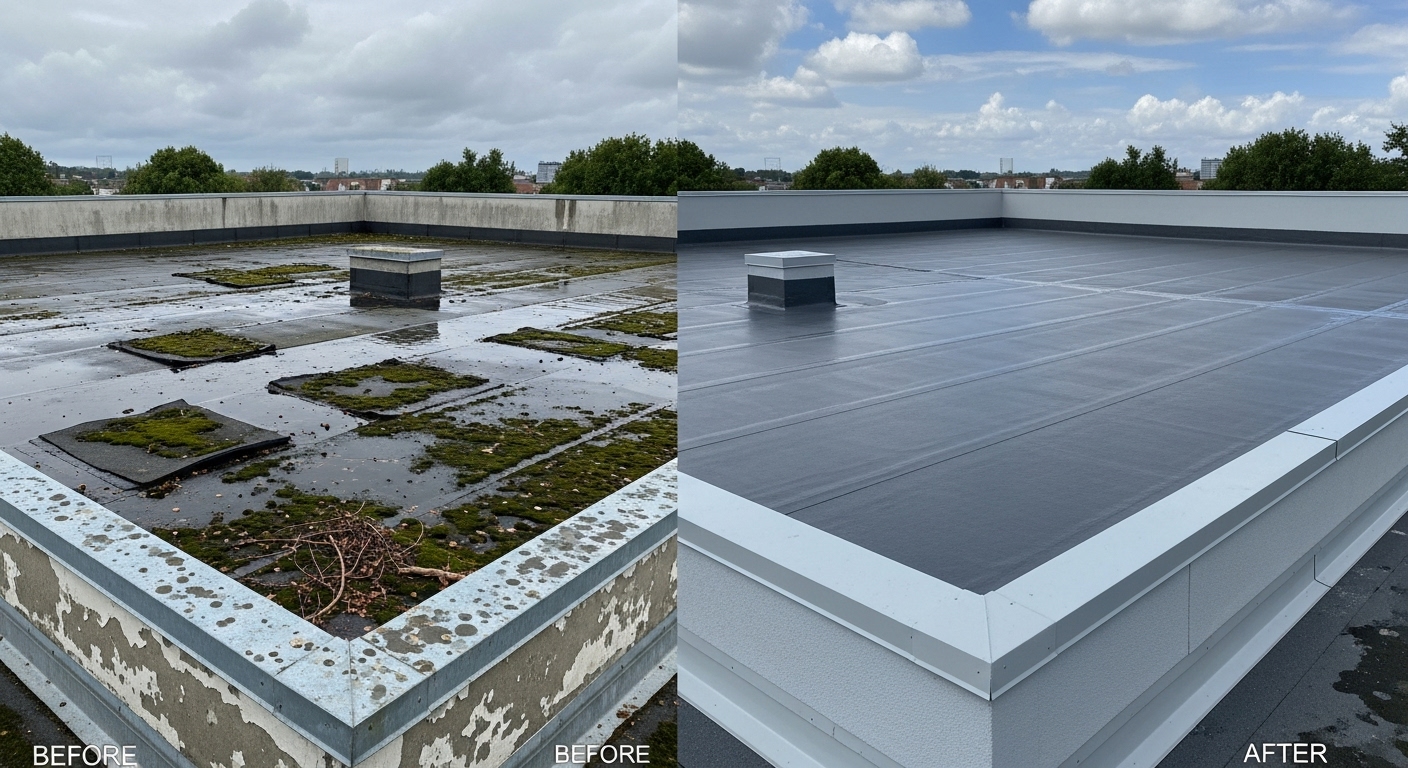
Before
- A separated seam with repeated surface sealant
- An unidentified leak and conflicting advice
- Standing water with no drainage discussion
- A replacement quote with unclear decking costs
After
- An appropriate system-compatible repair, with its scope explained
- Documented findings and a defined repair or replacement proposal
- Drainage included in the assessment and corrective options identified
- Stated allowances, exclusions, and change-order arrangements
These examples describe project objectives, not specific completed Hart Staff Roofing case studies.
How Flat-Roof Repairs and Replacements Are Planned
The right product still needs the right substrate and detail
A repair must be appropriate for the existing membrane, previous coatings, and surrounding condition. Applying a new product over dirt, loose repair material, or unresolved moisture can undermine the result.
Manufacturer guidance identifies EPDM primers and pressure-sensitive materials, while TPO and PVC repair kits include compatible membrane pieces and heat-welding tools.
Important Planning Considerations Include
- Identifying the existing membrane
- Checking product compatibility
- Preparing the repair area appropriately
- Assessing adjoining seams and flashing
- Addressing damaged underlying materials within the agreed scope
- Following the applicable system instructions
- Reviewing completed seams and details
A coating is a separate scope decision. It should not be presented as a substitute for correcting damaged decking or inadequate drainage.
Should You Repair the Flat Roof or Replace It?
The answer depends on more than the size of the visible leak
A localized defect on an otherwise serviceable roof may be repairable. Widespread deterioration, repeated failures, or significant underlying damage may justify a broader project.
| Roof Condition | Repair May Be Suitable When… | Replacement Deserves Consideration When… |
|---|---|---|
| Isolated puncture | Surrounding membrane and assembly are serviceable | Damage is part of broader deterioration |
| Local seam or flashing defect | The defect can be corrected appropriately | Multiple areas repeatedly fail |
| Recurring leak | The cause can be identified and addressed | Previous repairs have not resolved extensive problems |
| Wet underlying materials | A localized removal and rebuild is feasible | Moisture affects a substantial area |
| Low-slope section on a house | A targeted scope solves the detail | That section needs a complete new assembly |
| Ponding | Drainage corrections can be scoped appropriately | Broader rebuilding is needed to address the design or condition |
Replacement Becomes a Stronger Consideration When
- Defects are widespread
- The underlying assembly needs extensive corrective work
- Repeated patching no longer offers reasonable value
- A larger project is needed to address the roof's configuration
Homeowners commonly ask whether they can replace only a leaking section and whether a cheap patch merely delays another expense. Those are valid questions to resolve in the proposal.
How Much Does Flat-Roof Repair or Replacement Cost in Stafford?
Compare scope, not just the total
Your estimate should reflect the roof that is actually inspected. A small seam repair and a replacement involving damaged decking, new insulation, and drainage changes are not comparable projects.
Main Cost Drivers
- Roof area and height
- Access and safety requirements
- Existing membrane and layer count
- Extent of damage
- Insulation and decking condition
- Flashing and penetration complexity
- Drainage corrections
- Removal and disposal
- Emergency versus scheduled work
| Service Type | Estimate Basis |
|---|---|
| Diagnostic inspection | Size, access, complexity, and agreed investigation |
| Localized repair | Defect, preparation, compatible materials, and labor |
| Partial replacement | Defined section, transitions, and underlying work |
| Full replacement | Removal approach, assembly, details, and project logistics |
Ask whether damaged decking is included, how additional work is priced, and whether the quote solves any identified drainage problem.
When Should You Arrange a Flat-Roof Inspection?
You do not need to wait for a major interior leak
Arrange an assessment when you notice any of the signs below.
Arrange an Assessment When You Notice
- Water stains or active dripping — see water damage repair
- A leak returning after repair — try roof leak detection
- Open seams or damaged flashing
- Visible membrane tears
- Water remaining in the same areas
- A change in the roof's appearance or shape
- Questions about a recently resurfaced roof
- A replacement recommendation you do not understand
If the roof looks intact but the building leaks, further assessment may still be necessary. Water can travel within the assembly before appearing indoors.
Commercial Flat Roof Repair in Stafford, VA
Coordinate the roof project around your building's needs
Commercial owners need more than a repair recommendation. They need a workable plan for access, operating hours, tenant communication, project scope, and documentation.
Hart Staff Roofing welcomes inquiries from property managers, business owners, HOAs, and facilities teams seeking commercial roofing assistance.
| Commercial Service | Project Focus |
|---|---|
| Roof assessment | Document visible condition and identify next steps |
| Leak repair | Address the agreed source or affected detail |
| Replacement planning | Define materials, underlying work, and logistics |
| Maintenance planning | Prioritize inspections and corrective work |
| Emergency assistance | Discuss temporary protection and follow-up scope |
Property types include retail buildings, offices, hospitality properties, schools, community facilities, and warehouses.
Why Scope Coordination Matters
- Rooftop access may affect staff or tenants
- Equipment and penetrations require careful interface planning
- Work zones and material staging need consideration
- Large projects may benefit from phased planning
- Project records support future maintenance
| Project Type | Typical Planning Considerations |
|---|---|
| Multi-building property | Building-by-building scope and scheduling |
| Occupied premises | Access, noise, work zones, and communication |
| Large roof | Staging, material handling, and phased work |
| Restricted-access site | Site rules and agreed safety arrangements |
Why Hire a Professional Flat-Roof Contractor?
Diagnosis and scope are as important as the repair itself
Professional service should help you make a better decision about the building—not simply sell a product.
The value lies in matching the work to the problem, particularly when previous repairs have failed.
Why Flat-Roof Leaks and Unsafe Roof Access Need Caution
Do not climb onto a roof during hazardous conditions
Wet surfaces, roof edges, damaged decking, and poor weather can make roof access dangerous. Interior leaks also deserve caution when water affects electrical fixtures or a ceiling begins to sag.
Safety Guidance
- Keep people away from visibly compromised ceiling areas
- Do not touch wet electrical equipment
- Do not puncture a bulging ceiling
- Avoid rooftop access during storms or unsafe conditions
- Report the interior symptoms when requesting assistance
If there is an immediate threat to people, fire risk, or possible collapse, contact emergency services first.
Flat-Roof Repair & Replacement FAQs
Straightforward responses to common property-owner questions
Can my flat roof be repaired, or does it need replacement?
A localized defect may be repairable when the surrounding roof is serviceable. Widespread deterioration, recurring failures, or extensive underlying damage may make replacement more appropriate. Inspection findings should explain the recommendation.
Why does my flat roof still leak after it was patched?
The patch may not have addressed the actual entry point, the adjoining detail, or the underlying condition. Incompatible materials and inadequate preparation can also affect repairs. Consider our roof leak detection service.
Is standing water on a flat roof normal?
Persistent or recurring ponding deserves assessment. Carlisle's owner guidance states that good roofing practice is for drainage to occur and ponded water to evaporate within 48–72 hours after rainfall; your roof's manufacturer instructions and conditions still matter.
Will a coating stop water from pooling?
A coating does not by itself change the roof's slope or outlet arrangement. Drainage should be assessed separately.
Can you replace only the flat section of my roof?
A partial project may be possible if the boundaries, adjoining roof condition, and transitions allow an appropriate assembly. The proposal should explain how the replaced section connects to the rest of the building.
How do you identify whether the roof is EPDM, TPO, or PVC?
Assessment can include membrane characteristics, existing records, and system details. Repair materials should be selected only after the system is adequately identified.
What happens if the insulation or decking is wet?
The affected materials require evaluation. Your scope should state what removal, replacement, or additional investigation is included and how unforeseen work is handled.
How much time will a patch buy?
There is no reliable universal answer. Its usefulness depends on the defect, the repair method, and the condition of the remaining roof.
Do I need a Stafford County permit?
Requirements depend on the building and proposed work. Roof-covering work and structural changes should not be treated as the same scope. Clarify permit responsibility before work begins.
Does HOA approval replace a county permit?
Treat private community approval and government permit requirements as separate checks. Ask about both when relevant.
Are emergency services available?
Hart Staff Roofing offers 24/7 emergency availability. Call to discuss the symptoms, current conditions, and the appropriate next step.
Clear Scope, Clear Expectations, Responsive Support
Start with an assessment—not an assumption
Our priority is to help you understand the roof problem and the proposed work. Before authorizing a project, review the scope, exclusions, material details, and applicable warranty terms.
Reinforcing Statement
Any guarantee or corrective-work obligation should be stated in your written agreement. A general promise should never replace the specific terms that govern your project. Contact us if you have questions after work is completed.
Hart Staff Roofing
2834 Richmond HwyStafford, VA 22554
United States
Roofing Licenses and Certifications That Matter
Understand the business license and the proposed scope
Virginia contractor licensing distinguishes the license class from the classification or specialty. Roofing contracting is identified as ROC in Virginia's contractor regulations. These categories describe legal scope; they are not interchangeable with manufacturer training or award programs.
Credential Information to Review Includes
- Licensed business identity
- Contractor license number and status
- Applicable class
- Classification or specialty covering the work
- Manufacturer authorization where relevant to the proposed system
- Requirements for any specified manufacturer warranty
Ask for the credential information applicable to your project rather than relying on a generic "certified" label.
24/7 Emergency Flat-Roof Assistance in Stafford
Temporary protection and permanent repair are different stages
An active leak can force immediate decisions. Call Hart Staff Roofing to describe the affected area, the severity of the water entry, and whether people, equipment, or interiors are at risk.
Emergency Response Planning May Include
- Phone discussion of symptoms and urgency
- Assessment of access and current conditions
- Temporary mitigation where safe and appropriate
- Inspection and documentation
- A follow-up repair or replacement plan
Urgent Scenarios Include
- Water entering occupied spaces
- Storm-damaged membrane or flashing
- A rapidly worsening recurring leak
- Water threatening inventory or equipment
- Interior deterioration associated with ongoing leakage
Weather, access, and safety can affect when roof work is possible. Emergency availability is not a promise that a complete replacement can be performed immediately.
Support for Roof-Damage Insurance Claims
Understand what was observed and what work is proposed
When roof damage leads to an insurance inquiry, clear documentation can help you explain the condition and proposed corrective work.
Documentation Needs May Include
- Inspection photos
- Observed damage notes
- Repair or replacement scope
- Itemized estimates
- Completed-work invoices
- Available project records
Discuss With Your Insurer
- Actual cash value (ACV)
- Replacement cost value (RCV)
- Recoverable depreciation
- Wind and hail deductibles
- Covered perils vs. wear and tear exclusions
Coverage depends on your policy, cause of loss, exclusions, deductibles, and insurer's assessment. A roofing estimate does not establish that a claim is covered.
Flat-Roof Repair and Replacement Warranty Terms
Workmanship coverage and manufacturer coverage are different
The warranty for a localized repair may differ substantially from the warranty available for a complete new roof system. Review the actual written terms before choosing between proposals.
| Coverage Category | What to Understand |
|---|---|
| Workmanship | Covered labor, duration, exclusions, and remedy |
| Manufacturer material warranty | Covered product defects and applicable conditions |
| System warranty, where available | Eligibility, inspection requirements, and covered causes |
| Maintenance requirements | Actions needed to preserve applicable coverage |
| Claim procedure | Who to contact and what records to provide |
Keep the contract, specification, invoices, completion records, and warranty documents together. Manufacturer warranty options vary by system and terms; published options from one manufacturer should not be assumed to apply to every project.
Five Equipped Service Vans Supporting Stafford Projects
Match the crew and equipment to the job
Hart Staff Roofing's five equipped service vans support our local operations and service coordination. A small repair and a full replacement require different resources, so project planning should match the actual scope.
Equipment Needs May Include
- Roof-access and safety equipment
- Inspection and documentation tools
- System-compatible repair materials
- Membrane-specific application equipment
- Removal and material-handling arrangements for larger projects
Manufacturer repair guidance lists different materials and tools for EPDM, TPO, and PVC work, reinforcing why equipment selection depends on the roof system.
Payment and Financing Questions for Larger Roofing Projects
Understand the total obligation before choosing a payment option
When replacement is necessary, ask about payment arrangements or financing options applicable to your project.
Important Questions Include
- Is financing currently available?
- Is lender approval required?
- What interest rate or promotional period applies?
- Is interest deferred or waived?
- Are there fees?
- What happens when the promotional period ends?
- Does financing affect the project price?
- When are deposits and progress payments due?
Compare the total cost, not only the monthly payment. Any promotional arrangement should be provided in writing before you rely on it.
Recognition, Credentials, and Roofing Experience
An award is helpful context—not a substitute for a clear proposal
When comparing roofing businesses, consider recognition alongside the evidence that matters to your roof: relevant experience, an appropriate scope, clear communication, and written protection.
Distinguish Between
- Community or customer-service awards
- Trade-industry recognition
- Manufacturer contractor designations
- Product training
- Legal licensing
Ask about the company's relevant project experience and the credentials applicable to your selected roof system.
Senior, Military, Veteran, and Community Savings Inquiries
Understand eligibility before comparing project prices
If you are a senior homeowner, active-duty service member, veteran, or other community customer, ask whether a current offer applies to your project.
Discuss
- Current eligibility requirements
- Eligible service types
- Discount amount or calculation
- Minimum project value
- Expiration and exclusions
- Whether offers can be combined
Current Hart Staff Roofing Community Offers
- The "Complimentary Tune-Up" Assessment Bundle
- The "Hometown Heroes" Community Discount
- The "No Interest, No Payments" Financing Promo
- The "Roof & Gutter Combo" Discount
- The "Tiered Project Value" Markdown
A qualifying discount should appear clearly in the estimate. Do not assume that every promotion applies to emergency work, repairs, financing, or full replacement.
Hart Staff Roofing Hours in Stafford, VA
Contact us when you need help; schedule the work appropriately
Hart Staff Roofing's supplied operating schedule is 24 hours a day, seven days a week, with emergency availability throughout the week.
| Day | Availability |
|---|---|
| Monday | 24 hours |
| Tuesday | 24 hours |
| Wednesday | 24 hours |
| Thursday | 24 hours |
| Friday | 24 hours |
| Saturday | 24 hours |
| Sunday | 24 hours |
Inspections and permanent roof work are scheduled according to project needs, access, weather, and safety.
How to Compare Flat-Roof Contractors in Stafford
Choose a clear proposal rather than unsupported promises
Two estimates may describe different solutions even when they concern the same leak. Compare the diagnosis, included work, materials, exclusions, and warranty—not just the price.
| Comparison Point | What to Ask Any Provider | What to Discuss with Hart Staff Roofing |
|---|---|---|
| Diagnosis | What evidence supports the recommendation? | Inspection findings and scope |
| Roof system | Is the repair suitable for this membrane? | Material identification and method |
| Drainage | Does the quote address standing water? | Included corrections and exclusions |
| Underlying materials | What happens if decking is damaged? | Allowances and additional-work pricing |
| Availability | What can be done now versus later? | Emergency and scheduled-work options |
| Warranty | What is covered, and for how long? | Project-specific written terms |
| Local resources | How will the project be coordinated? | Stafford team and service operations |
A more expensive proposal may include necessary work omitted from a cheaper quote. A lower-priced repair may also be reasonable if it addresses an isolated defect. Understanding the difference is the purpose of the comparison.
Contact Hart Staff Roofing for Flat-Roof Repair & Replacement
Tell us what is happening and get a defined next step
Is your flat roof still leaking after a repair? Is water collecting in the same area after rain? Have you been told to replace the roof without a clear explanation?
Contact Hart Staff Roofing to discuss an inspection, a recurring leak, a low-slope section, or a commercial replacement project. Share your property address, roof type if known, previous repair history, and any interior symptoms.
Contact Hart Staff Roofing
+1 (540) 930-6660
hartstaffroofing@gmail.com
2834 Richmond Hwy
Stafford, VA 22554, USA
Flat Roof Repair & Replacement
24/7 Emergency Service Available
For flat roof repair in Stafford, VA, contact Hart Staff Roofing to discuss the cause of the problem, the available options, and the work your property needs.
Flat Roofing — Service Area Coverage
Our team serves Alexandria, Arlington, McLean, Reston, and all of Stafford County.